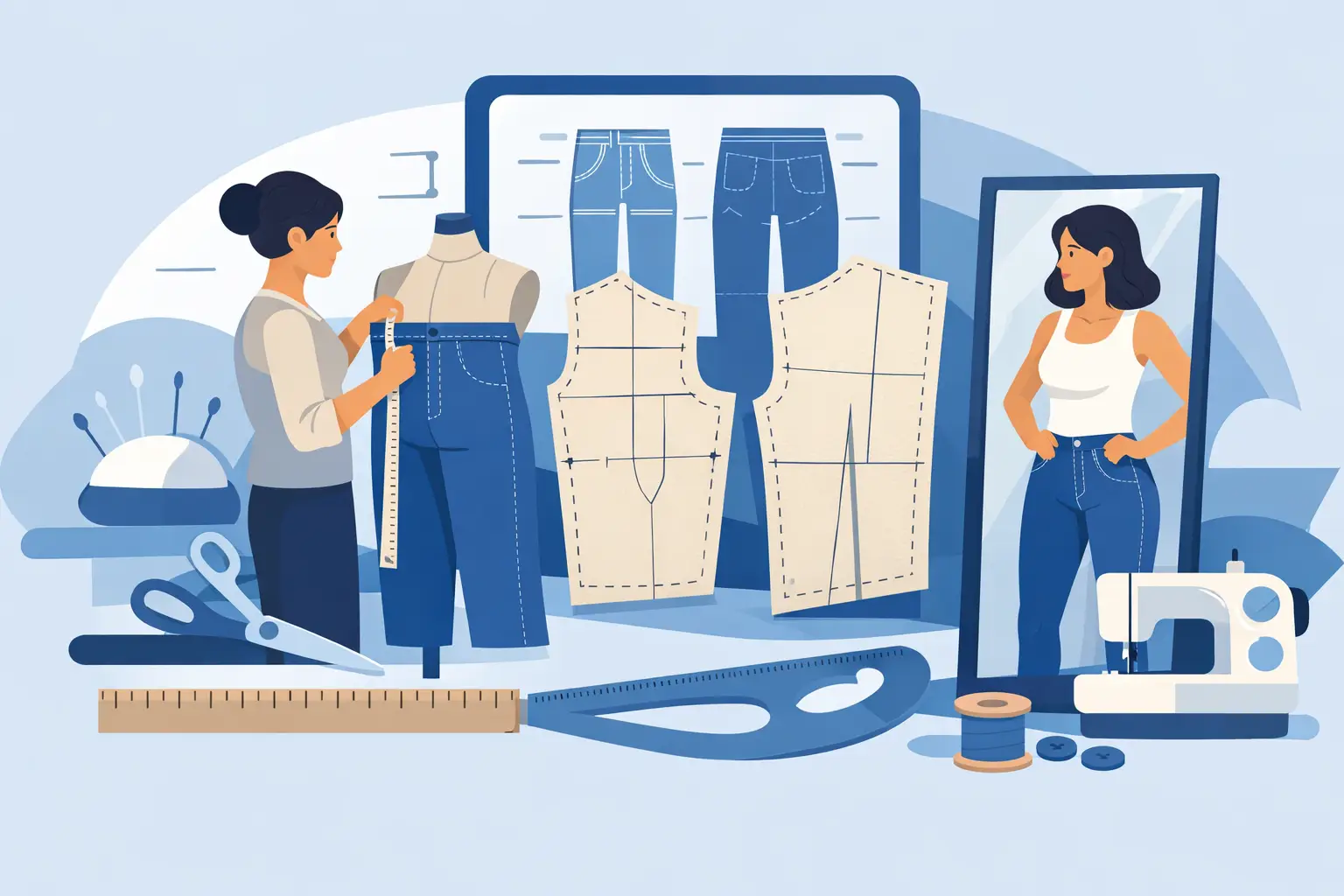
A denim sketch can look market-ready on paper and still fail in the sample room. The usual problem is not the wash or the fabric. It is the pattern. A strong denim pattern making service turns a design concept into a production-ready structure that fits correctly, holds shape through wash development, and scales cleanly across sizes.
For fashion brands, sourcing teams, and product developers, pattern accuracy affects much more than fit. It influences sample speed, material consumption, sewing efficiency, grading consistency, and final QC results. In denim manufacturing, where shrinkage, weight, stretch, and wash effects all interact, pattern making is not a support step. It is a technical control point.
Why denim pattern making is different
Denim is less forgiving than many casualwear fabrics. A woven 100% cotton rigid denim behaves very differently from a comfort-stretch or performance-blend fabric. Rise balance, thigh tolerance, knee shape, leg twist risk, waistband stability, and seam allowance strategy all need to be considered before the first sample is cut.
That is why a denim pattern making service should not be treated like generic apparel pattern development. Denim products have category-specific construction standards. Jeans need accurate front and back balance, pocket placement that supports fit and visual proportion, and pattern engineering that still performs after sanding, enzyme wash, stone wash, or other finishing methods. Jackets, skirts, and shorts have their own technical requirements, especially when brands want a specific silhouette but also need efficient bulk production.
A pattern may look correct in a CAD file and still create problems in sewing. This usually shows up as torque on the side seam, drag lines at the crotch, waistband gaping, or poor size jumps during grading. Those issues become more expensive once fabric has been sourced and multiple rounds of samples have already started.
What a denim pattern making service should include
A reliable denim pattern making service begins with interpretation, not tracing. The factory or development team needs to understand the target fit, customer profile, intended wash effect, fabric composition, and price level. A premium straight-leg jean for a contemporary label will require a different pattern approach than a value-focused skinny fit for mass retail.
In practical terms, the service should cover base pattern development, fit review, size grading, construction planning, and sample support. If the provider only supplies a flat pattern without connecting it to sewing methods and bulk production realities, the service is incomplete.
Fit translation from design to pattern
Many tech packs show the style direction clearly but leave room for interpretation in fit. A good pattern maker closes that gap. They translate design intent into actual body measurements, shape lines, and tolerances that a sample room can execute.
This matters most with denim because small pattern changes produce visible results. A minor adjustment to back rise angle, inseam curve, or yoke depth can improve comfort and visual balance immediately. Without category experience, those decisions often turn into repeated fitting corrections.
Pattern planning for washes and shrinkage
Denim development rarely ends with sewing. Washing changes the garment. Depending on fabric composition and finishing process, the final garment can shrink, soften, twist, or relax in ways that affect fit.
A technically sound pattern accounts for these variables from the beginning. That includes building shrinkage allowances into the pattern, checking how stretch recovery affects body measurements, and aligning fit targets with the expected post-wash result. This is one of the main reasons brands benefit from working with a manufacturer that understands both pattern engineering and wash development.
Grading that holds across sizes
A sample can fit well in one size and fail completely in the size set. Poor grading causes this. In denim, grading is not just about increasing circumference and length at fixed intervals. Proportion has to remain consistent across the size range.
For example, pocket size, knee position, rise progression, and leg shape all need careful control. If grading is too mechanical, smaller sizes can become overbuilt and larger sizes can lose the intended silhouette. A strong development partner checks grading against the brand’s target customer and sales channel, because fit expectations differ by market.
How pattern quality affects cost and speed
Many buyers focus first on fabric price, MOQ, and sample lead time. Those are valid priorities. But pattern quality has a direct effect on all three.
When the pattern is accurate early, sampling moves faster. Fewer fit corrections mean fewer remake costs and shorter approval cycles. Fabric usage can also be managed more effectively because marker planning becomes more stable once the pattern is finalized.
On the production floor, a clean pattern supports sewing consistency. Operators work more efficiently when notches align, seam shapes are practical, and construction details are production-ready. That reduces variation between pieces and lowers the risk of rework during inline and final inspection.
This is especially important for brands running tight launch calendars. If a collection depends on a 10-15 day sample timeline and a defined bulk delivery window, delays in pattern correction can affect the whole calendar. The earlier the pattern is right, the more predictable the rest of the process becomes.
What buyers should prepare before requesting a service
The better the input, the better the output. A denim pattern making service works best when the brand provides a clear technical brief. That can include sketches, measurement specs, reference samples, fit comments, target fabric type, stretch percentage, wash direction, and trim details.
If some of that information is still open, that is manageable, but priorities should be clear. For example, is the main goal a vintage rigid fit, a clean commercial fit with broad size acceptance, or a fashion-forward shape for a short seasonal run? Each route changes the development logic.
Buyers should also define whether they need ODM support or OEM execution. If the design is still evolving, the factory’s development input becomes more valuable. If the tech pack is already mature, the focus shifts toward accuracy, speed, and production compliance.
Choosing the right denim pattern making partner
Not every factory with a sample room offers a dependable denim pattern making service. Buyers should look for evidence of category specialization and production integration.
First, check whether the team has real denim experience across jeans, jackets, skirts, and shorts, not just general bottoms. Second, ask how pattern development connects to wash testing, fit approval, and size grading. Third, confirm that the provider can support both low-volume development and scalable bulk production.
This matters because a pattern that works for one proto sample may not be practical for repeat orders at scale. Pocket construction, seam tolerances, and waistband methods all need to hold up in bulk. A capable manufacturing partner understands both the sample-stage ideal and the production-stage reality.
Tuopu Apparel, for example, supports this process as part of an end-to-end denim development model, which is often more efficient for brands that want fewer handoffs between design, sampling, and bulk execution.
Common mistakes that create fit and production problems
Some issues appear again and again in denim development. One is building patterns from non-comparable reference garments. A stretch skinny jean cannot simply be converted into a rigid straight fit with a few measurement edits. The structure is different.
Another mistake is approving fit before wash confirmation. A garment can fit correctly in raw form and miss the target after finishing. That is why wash-informed pattern adjustment matters.
A third problem is underestimating the role of grading. Brands sometimes focus heavily on the salesman sample and delay grading review until later. By then, correcting the full size range can slow production.
There is also a commercial mistake: choosing the cheapest development option without considering how many sample rounds it may create. Lower upfront pattern costs can lead to higher overall development expense if fit issues continue through multiple revisions.
When custom pattern development makes the most sense
Custom development is especially valuable when a brand is building signature fits, entering a new denim category, or trying to improve consistency across repeat orders. It also makes sense when the target market has specific fit expectations, such as premium women’s denim with a defined shape standard or men’s bottoms with a narrow tolerance for rise and seat balance.
For newer brands, custom pattern work can prevent expensive trial and error. For established brands, it supports standardization across suppliers and seasons. In both cases, the real value is control. Better control over fit. Better control over timing. Better control over bulk quality.
A denim product succeeds when design, fabric, wash, pattern, and production all support the same result. If one part is weak, the garment shows it quickly. That is why the right denim pattern making service is not just about getting a sample made. It is about building a denim program that performs well from the first fitting to the final carton.
One response
[…] adjustments to the thigh and back-rise shape while preserving the intended high-rise profile. The wide-leg pattern was refined to improve grain alignment and leg balance. For the jacket, the wash recipe was […]