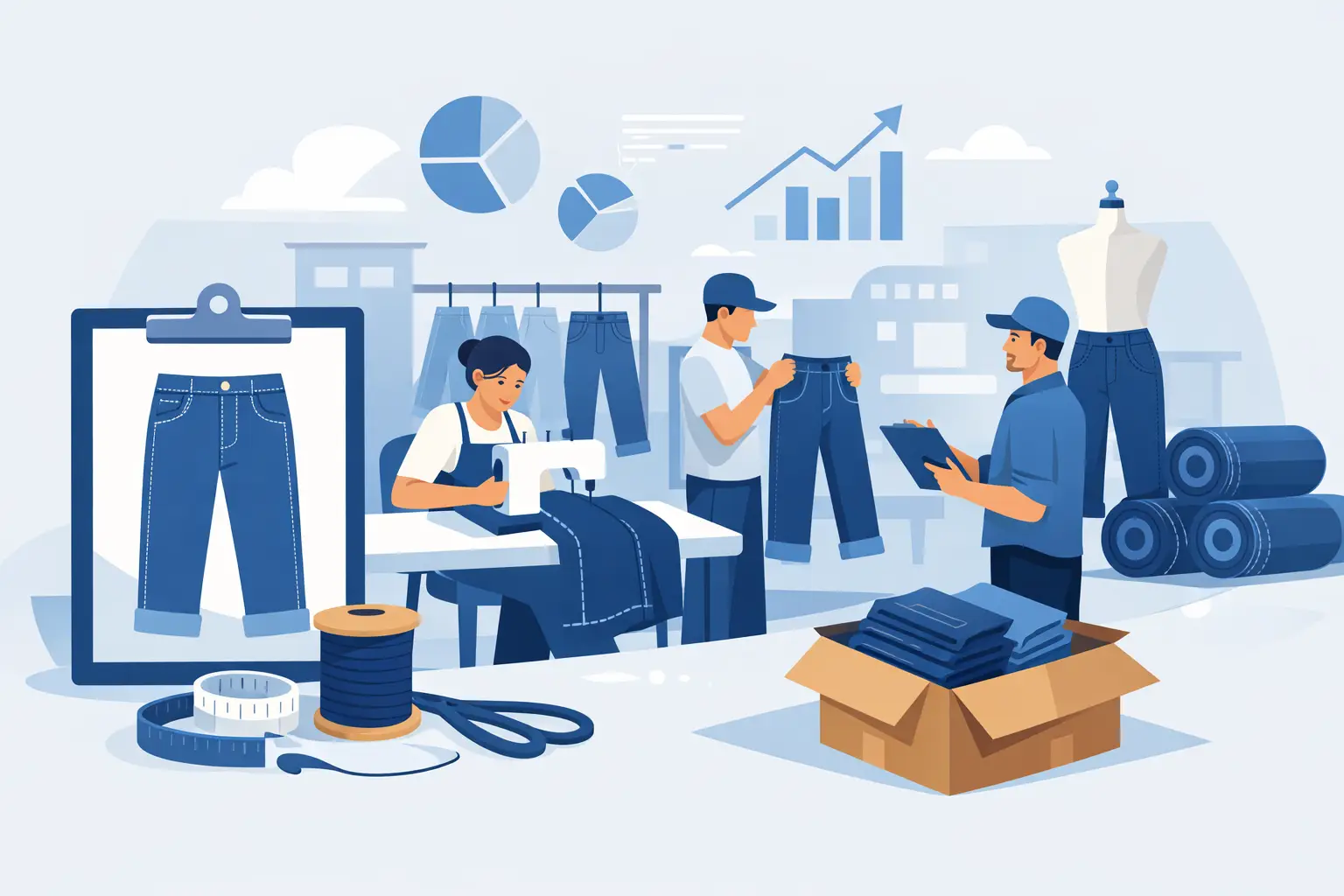
A first denim order can fail long before bulk cutting begins. A fit that looks right in a digital tech pack may pull at the knee, a wash reference may not translate to the selected fabric, and an ambitious size range can push inventory beyond what a new brand can realistically sell. This denim startup production case study shows how a controlled development process can turn a first collection into a commercially manageable production run.
The scenario is representative of the issues emerging brands bring to a denim manufacturer: a concise capsule collection, a defined visual direction, limited forecasting history, and a need to launch quickly without accepting avoidable quality risk. The objective was not simply to make jeans. It was to create repeatable specifications that could support a second order with fewer corrections, better costing visibility, and dependable consistency.
Denim Startup Production Case Study: The Starting Brief
The startup planned an initial three-style launch: a high-rise straight jean, a relaxed wide-leg jean, and an oversized denim jacket. The brand had mood boards, competitor references, rough measurement targets, and logo artwork, but it did not yet have production-ready patterns or approved wash standards.
Its commercial constraints were typical for an early-stage label. The brand needed enough units to support a credible launch across ecommerce, wholesale outreach, and seeding activity, but it could not carry a large inventory position. A 300-piece MOQ per style offered a practical starting point, allowing the team to test demand without committing to a factory-scale buy that exceeded its working capital.
The first production decision was to separate what the brand wanted aesthetically from what could be controlled consistently in bulk. This matters particularly in denim. Terms such as “vintage blue,” “soft handfeel,” and “worn-in fade” are useful creative directions, but they are not complete manufacturing instructions. A factory needs fabric weight, fiber composition, construction details, wash process, trim specifications, measurement tolerances, and approved reference samples.
Converting Creative Direction Into Production Specifications
The development team began by reviewing each style for construction complexity and material risk. The straight jean used a rigid cotton fabric with a classic five-pocket build. The wide-leg jean required more attention because the intended drape depended on fabric weight and leg-panel balance. The jacket included a dropped shoulder, custom metal hardware, and a heavier wash treatment that could affect shrinkage and seam appearance.
Rather than sourcing all materials independently, the startup worked through a coordinated fabric and trim selection process. This reduced the risk of choosing a fabric that looked right on a swatch but reacted poorly during washing. Denim development is interconnected: fabric, pattern, sewing thread, labels, rivets, buttons, and wash methods must work together.
The team selected a small number of fabric options and tested them against the desired product position. A heavier rigid denim delivered stronger structure for the jacket and straight jean, while a slightly softer construction was considered for the wide-leg style. The final choice depended on more than appearance. It also had to meet shrinkage expectations, hold the intended silhouette, and remain available for potential reorders.
At this stage, the startup also narrowed its color offering. Launching every style in multiple washes would have increased SKU count, sampling time, and inventory exposure. The collection moved forward with one core wash per style, plus a single alternate wash for the straight jean. That decision kept the assortment visually coherent and made the first order easier to manage.
Sampling Exposed the Problems Before Bulk Production
A sample is not a formality. It is where a startup learns whether its design choices survive real manufacturing conditions. For this project, the first sample round was completed within a 10-15 day development window after materials and specifications were confirmed.
The initial fit samples revealed three issues. The straight jean had too much tension through the upper thigh when sitting. The wide-leg jean looked balanced on the front but twisted slightly at the outseam after washing. The jacket’s chosen wash created more abrasion around the seams than the brand wanted.
None of these issues required restarting the project, but each required a specific correction. The straight jean received adjustments to the thigh and back-rise shape while preserving the intended high-rise profile. The wide-leg pattern was refined to improve grain alignment and leg balance. For the jacket, the wash recipe was modified to reduce seam abrasion while maintaining a faded appearance.
This is why approving a sample from photos alone is risky. Fit, handfeel, wash character, and construction quality need physical review. Brands should assess samples on more than one body type when possible, then record comments in a clear revision sheet. Vague feedback such as “make it more relaxed” can create new problems. Precise feedback such as “add 0.5 inch to the thigh at 2 inches below crotch while holding hem width” is actionable.
Wash Development Was the Critical Control Point
For denim, wash development often determines whether a product feels premium or generic. The startup wanted a clean, lightly aged look rather than heavy distressing. The challenge was achieving enough visual depth without creating excessive variation from garment to garment.
The production team developed wash panels and revised the formula based on shade, contrast, handfeel, and damage level. The approved standard defined the target wash appearance, but it also established acceptable variation. Some variation is inherent in garment washing, especially with indigo denim. The goal is not to eliminate all variation. It is to keep that variation within a range the brand can sell confidently.
The final wash specification included the approved shade reference, enzyme treatment level, drying approach, and placement expectations for localized fading. It also accounted for shrinkage after washing so the bulk cutting measurements could be set correctly. Without this step, a brand may approve a pre-wash fit and receive a post-wash garment that is too short, too narrow, or inconsistent by size.
Bulk Planning Balanced Cash Flow and Availability
Once samples were approved, the startup faced a familiar question: order more to reduce unit cost, or order less to protect cash? There is no universal answer. A lower unit cost can be attractive, but it becomes expensive if inventory remains unsold. For a first launch, controlled exposure is often more valuable than chasing the lowest possible price.
The brand placed a focused opening order built around its strongest commercial style, the straight jean. The wide-leg jean and jacket were produced in lower quantities but retained enough units for product photography, launch demand, selected wholesale conversations, and post-launch replenishment analysis.
Size ratios were another important decision. Without reliable sales history, the brand avoided distributing units evenly across all sizes. Instead, it used its customer profile, fit intent, and market benchmarks to create a weighted size run. This approach is not perfect, but it is more disciplined than treating every size as equally likely to sell.
A factory with flexible production planning can help at this point by identifying where consolidation is possible. Shared fabric across styles, common trims, and coordinated wash schedules can support efficiency without forcing the brand into oversized quantities. Tuopu Apparel supports this kind of development-to-bulk coordination for brands that need low-MOQ denim production alongside scalable capacity.
Quality Control Focused on What Customers Notice First
Pre-shipment inspection was structured around the defects most likely to create returns or damage brand perception. Measurements were checked against approved tolerances, with particular attention to inseam, rise, waist, thigh, and hem opening. Inspectors also reviewed wash consistency, pocket placement, stitching quality, zipper function, hardware attachment, label accuracy, and overall garment appearance.
For the jacket, seam puckering and hardware security received additional attention. For the jeans, the team checked leg twist after washing and compared finished garments against the approved sample. Packaging was reviewed as part of the final process because wrong size stickers, incorrect folding, or missing care labels can create avoidable fulfillment problems even when the garment itself is correct.
The key lesson was that quality control should begin before final inspection. Clear patterns, approved samples, wash standards, and inline checks prevent more problems than a last-minute audit can solve. Final inspection verifies the result. Process control produces the result.
What the Startup Could Carry Into Its Second Order
The first run created more than inventory. It created a usable production foundation. The startup now had approved patterns, measured size specifications, a defined wash standard, confirmed trim details, and a clearer understanding of which style and size combinations attracted demand.
For the second order, the brand could make decisions from sales data rather than assumptions. It could increase quantities for the best-selling straight jean, adjust the size ratio, and decide whether the jacket deserved a new wash or should remain a limited seasonal piece. Sampling could also move faster because the core construction and fit standards were already established.
The practical value of a first denim production run is not perfection. It is controlled learning. A startup that keeps its first collection focused, documents every approval, and works with a manufacturer that understands denim-specific fit and wash variables is far better positioned to scale without losing product consistency.
No responses yet