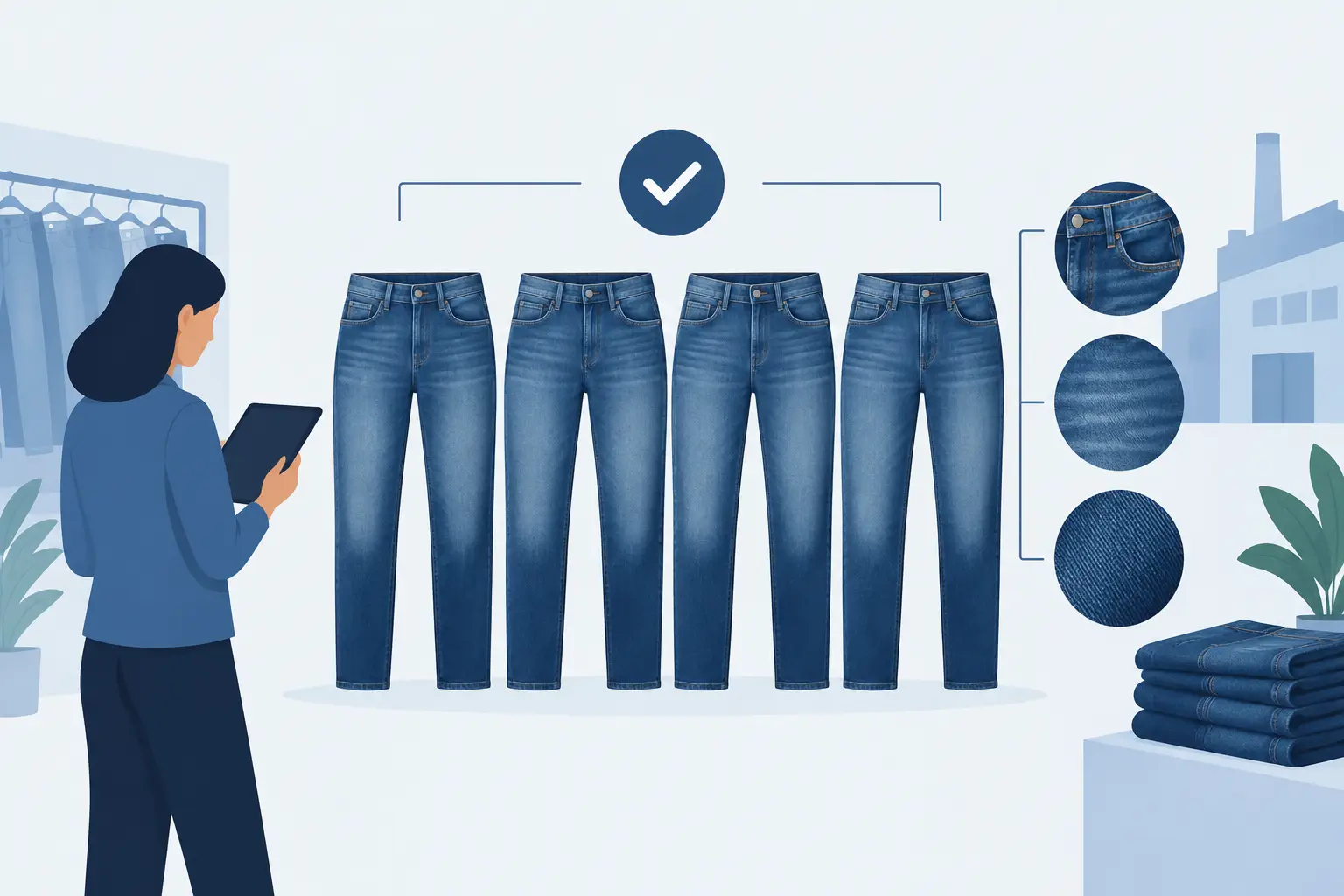
A wash-approved denim sample can still become a production problem. The first sample may have the right cast, contrast, softness, and abrasion pattern, while the first bulk cartons arrive darker, stiffer, or visibly uneven from one size run to the next. For a brand, that gap creates delayed launches, rejected goods, margin pressure, and customer complaints. This denim wash consistency case study shows how a controlled development-to-bulk process reduced that risk for a growing contemporary label.
The project involved a women’s straight-leg jean in a mid-blue, worn-in wash. The brand needed a vintage appearance with localized fading at the thighs and seat, light whiskering, a soft hand feel, and clean pocket edges. The initial order was intentionally conservative: 1,200 pieces across five sizes. That quantity was large enough to require real production discipline, but small enough that a conventional factory might deprioritize the program.
The Production Challenge Was Not the Wash Formula Alone
The approved development sample looked correct under showroom lighting. It had a balanced blue tone, clear but not exaggerated highs and lows, and no excessive yellow cast. However, the brand’s technical team had experienced inconsistency on similar programs before. Their concern was not whether the mill or laundry could create the effect once. The concern was whether every production lot would deliver the same commercial appearance.
Denim wash consistency depends on a chain of controlled variables. Fabric lot variation changes the starting shade and indigo behavior. Garment weight per load affects abrasion and chemical exposure. Enzyme activity, water temperature, machine speed, drying conditions, and operator handling all influence the final result. Even a correct wash recipe can produce different outcomes when the process conditions change.
For this program, the risk was elevated because the desired look relied on restraint. Heavy destruction or strong bleaching can hide minor shade variation. A refined medium wash cannot. Small differences in cast and contrast become obvious when garments are displayed side by side on a retail rack.
Building a Denim Wash Consistency Case Study Around Control Points
The first production decision was to define the approved sample as more than a visual reference. It became the benchmark for measurable production standards. Before bulk cutting, the development, production, and quality teams aligned on the acceptable range for overall shade, localized fading, hand feel, and garment measurements after washing.
A sealed approval sample was retained at the factory. Additional reference swatches documented the target blue cast under standardized lighting. This matters because wash discussions based on photographs alone often fail. Camera settings, screen calibration, and ambient lighting can make the same garment appear significantly different. Physical standards give production teams a common point of reference.
The team then reviewed the raw denim before bulk production. Fabric was checked by roll for shade direction, weight, stretch recovery, and surface character. Rolls with visible shade differences were separated rather than mixed randomly through cutting. Where possible, garments from the same fabric group were kept together through cutting and washing.
This step does not eliminate all variation. Denim is a natural variable material, especially when indigo-dyed. It does prevent a more serious issue: combining fabrics with different starting shades in the same wash load and expecting chemistry to correct the difference later.
Converting the Sample Into a Repeatable Wash Route
The approved garment was analyzed in sequence. The wash route included desizing, controlled enzyme washing, a low-intensity bleach adjustment, neutralization, softening, extraction, drying, and final hand sanding at defined zones. Each operation had a purpose, but just as importantly, each operation had a documented range.
Instead of recording only chemical names and quantities, the wash sheet specified water ratio, load quantity, processing time, temperature, machine type, and drying target. The laundry also recorded the actual conditions for the pilot run. That created a usable production record rather than a formula that depended on memory or individual operator judgment.
The brand requested a soft, broken-in hand feel without over-softening the garment. Excess softener could make the jean feel more luxurious at inspection but reduce the dry, vintage character the design required. The team therefore compared hand feel against the approved sample after a standard conditioning period, not immediately after drying when the garment could feel temporarily different.
Pilot Bulk Exposed the Real Risks Early
Before full production, a pilot bulk lot was washed using production fabric, production sewing methods, and the intended load size. This was the most valuable stage of the project. A development sample can be washed in a small, carefully handled load. A pilot bulk run tests whether the look survives real manufacturing conditions.
The first pilot revealed two issues. The garments were slightly darker than the approved sample, and the whiskers were less visible on larger sizes. Neither issue was severe, but both would have become more costly after several hundred pieces were processed.
The darker result was traced to a combination of higher fabric density in the production lot and a lower-than-target mechanical action in the wash load. The solution was not to add aggressive bleaching. That would have increased contrast and risked an uneven appearance. Instead, the team adjusted the enzyme stage and load configuration, then confirmed the revised result through a second pilot.
The weaker whiskers on larger sizes required a separate correction. Whisker placement and pressure were adjusted by size group so that the effect remained proportional to the garment panel. This is a practical example of why a single sample is not enough for a size range. An effect that looks balanced on a size 27 can appear faint on a size 32 or overly concentrated on a smaller size.
Bulk Production Used Lot Discipline, Not Visual Guesswork
After pilot approval, production was released in controlled wash lots. Each lot was checked against the retained standard before the next lot moved forward. Quality staff reviewed shade, contrast, abrasion placement, pocket appearance, hand feel, and post-wash measurements. Garments were evaluated under consistent lighting, with comparison samples placed side by side.
The process also accounted for the fact that not every visual difference is a defect. Denim is expected to carry some character. The goal was not to make every jean chemically identical. The goal was to keep natural variation within a range that looks intentional and commercially consistent.
When a lot showed a slightly cooler blue cast after drying, the team isolated it before finishing. It was not mixed automatically with previously approved output. A recheck confirmed that the difference remained within the agreed standard, so the lot was released with the rest of production. This avoided unnecessary rework while protecting the brand from accepting material outside the visual range.
That distinction is commercially important. Overcorrecting every minor variation can increase processing time, damage fabric strength, and create avoidable cost. Under-controlling variation can create mismatched retail inventory. The right standard is one that reflects the product’s intended look, price point, and customer expectations.
Results and What Buyers Should Apply
The final shipment maintained a consistent medium-blue appearance across the production run, with controlled fading and a hand feel aligned with the approved sample. The brand avoided the common outcome of approving a beautiful development sample and receiving bulk goods that needed broad rework or late-stage sorting.
The project also established a repeatable reference for future replenishment orders. That does not mean a later production run will be identical without review. New fabric lots, seasonal humidity, machine loading, and wash chemistry can all affect results. It means the brand now has a documented wash route, approved standards, and pilot process that reduce uncertainty before bulk commitment.
For sourcing teams, the key lesson is to evaluate a denim manufacturer’s wash capability as a process-control capability. Ask how fabric lots are managed, how pilot bulk is approved, how wash conditions are recorded, and how shade is assessed before packing. A factory that says it can match a sample should also be able to explain how it protects that match across production.
Tuopu Apparel applies this type of control from sampling through bulk production, supporting brands that need specialized denim execution without oversized production commitments. With low MOQ options starting at 300 pieces and sample lead times typically targeted at 10 to 15 days, the process gives buyers room to validate a wash before inventory risk grows.
The most reliable wash result is not created at final inspection. It is built into the fabric review, pilot run, documented wash route, and lot-by-lot decisions that happen long before cartons are sealed.
No responses yet