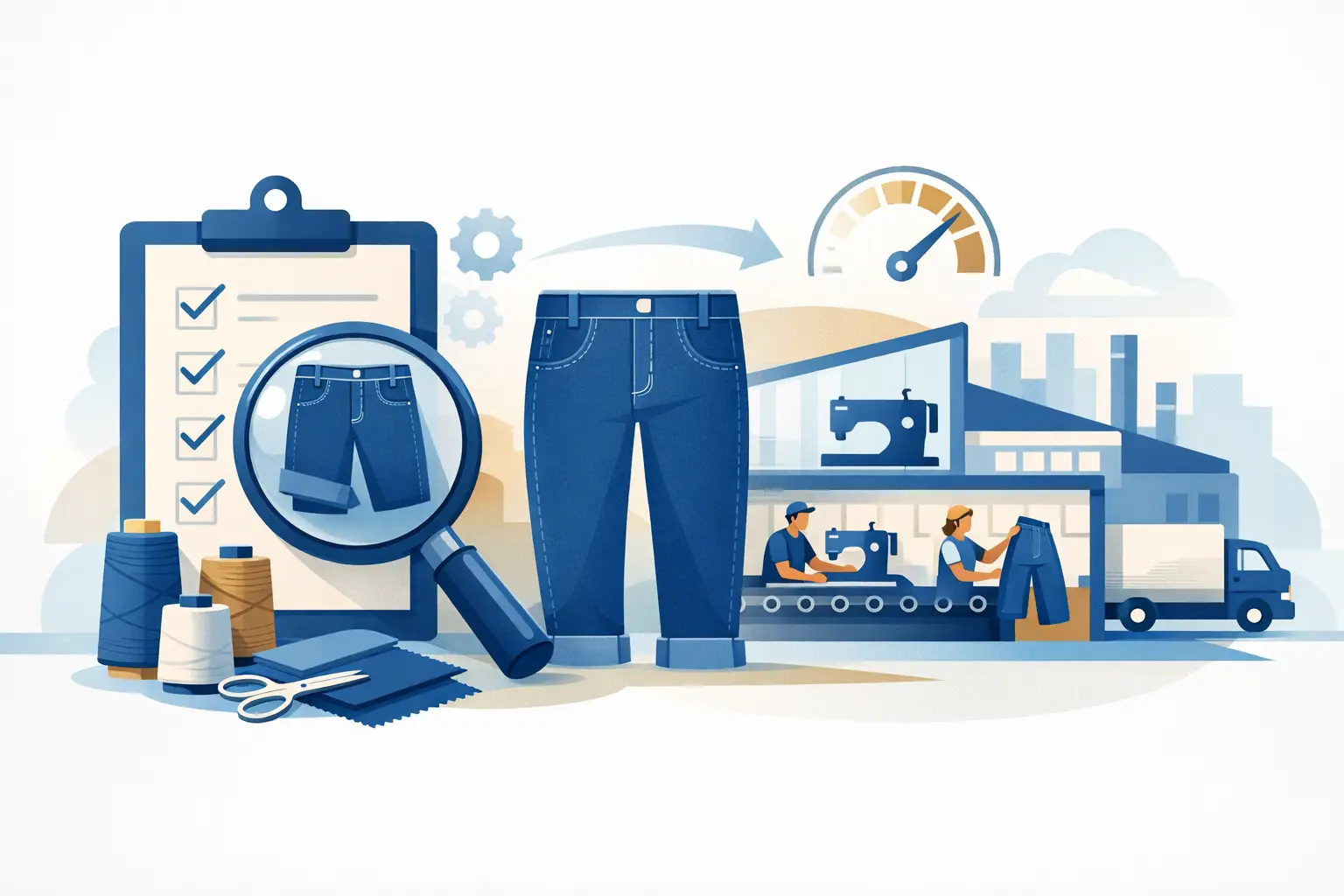
A missed sample window can push an entire denim launch off schedule. For brands working on seasonal drops, private label programs, or trend-led capsules, the value of a fast sample denim factory is not just speed. It is the ability to make better decisions earlier, reduce development risk, and move into production with fewer surprises.
In denim, sample development affects almost everything that follows. Fit approval, fabric confirmation, wash execution, trim matching, costing, and delivery planning all depend on how efficiently the factory can translate a tech pack or reference garment into a real product. When sampling drags, merchandising slows down, sales timelines tighten, and bulk production gets compressed into a smaller window.
Why a fast sample denim factory matters
Denim is more complex than many casual categories. A basic woven top sample may move quickly with limited variables, but jeans and denim jackets involve pattern balance, stitch construction, shrinkage control, wash testing, hardware selection, and fit correction. Even a simple five-pocket jean can require multiple adjustments before the shape, hand feel, and finish are commercially right.
That is why speed alone is not enough. A fast sample denim factory needs to be fast in a controlled way. If the first sample arrives quickly but has poor fit, inconsistent wash appearance, or the wrong fabric behavior, the development cycle is still slow. Real speed comes from reducing the number of revisions needed to reach approval.
For buyers and product teams, this has direct commercial value. Faster approval cycles support earlier line finalization, more accurate costing, and better inventory planning. It also gives brands more room to test trend-sensitive products without committing to large quantities too early.
What buyers should expect from a fast sample denim factory
A capable factory should offer more than a short sample lead time. It should have the internal structure to support sample accuracy from the start. In practice, that means pattern development, sourcing coordination, washing expertise, and sample room execution need to be aligned.
Technical development should happen before sewing starts
Many sample delays happen before the first cut is made. Tech packs may be incomplete, measurements may conflict, or the requested wash may not be suitable for the selected fabric weight. A strong development team will identify those issues early instead of simply producing what is on paper and leaving the brand to discover the problems later.
This is where technical denim knowledge matters. Rise balance, leg shape, seam torque, pocket placement, and post-wash shrinkage all affect final appearance. A factory that understands denim construction can flag risks before they become expensive revisions.
Wash capability is part of sample speed
For denim, wash development is often the longest part of the sample process. Sanding, whiskering, enzyme treatment, garment dyeing, coating, tinting, and destruction effects all require testing and control. If wash execution is weak, the sample may arrive on time but still fail approval.
A factory with strong wash capabilities can move faster because it already understands how different denim fabrics respond to treatment. That reduces trial and error. It also helps protect consistency later when the style moves into bulk production.
Trims and fabric sourcing must support quick turnaround
Fast sampling depends on material availability. If the factory has access to a reliable denim supply base and commonly used trims, development can begin immediately. If every item must be sourced from scratch, the lead time expands quickly.
This does not mean buyers should accept substitute materials without approval. It means the factory should know how to propose practical options that match target quality, price, and timing. For development-stage programs, that flexibility can keep the calendar moving.
How to evaluate a factory’s sampling speed realistically
Many factories advertise fast development, but buyers should ask how that speed is achieved. There is a difference between a factory that has a real sample system and one that simply promises short timelines to win inquiries.
The first point to review is actual sample lead time by product type. A denim short with a basic wash is not the same as a women’s high-rise flare jean with heavy abrasion, special hardware, and multiple fit comments expected. Lead times should reflect product complexity.
The second point is communication rhythm. Fast sampling requires fast clarification. If the factory takes two or three days to respond to questions about measurements, fabric substitutions, or wash references, the process slows down even if the sewing room is efficient. Reliable development partners maintain clear communication during every stage of sample execution.
The third point is revision discipline. Ask how fit comments are handled, how revised patterns are approved, and whether wash comments are tracked separately from garment construction comments. Organized factories shorten development because they prevent the same errors from repeating in each round.
The connection between fast samples and low-MOQ production
For many emerging and growing brands, sample speed matters most when paired with production flexibility. A fast sample is useful, but it becomes far more valuable when the factory can also support lower MOQ bulk orders after approval.
This is especially relevant for brands testing new fits, launching denim for the first time, or planning limited seasonal drops. They need to move quickly, but they also need to control inventory exposure. A factory that combines rapid development with flexible production quantities gives buyers more room to validate styles before scaling.
That balance is often difficult to find. Some factories handle samples well but require large production commitments. Others accept small orders but lack the technical depth to execute denim development properly. The better manufacturing partners do both, which is why many buyers prioritize integrated capabilities over headline speed claims.
Why development-to-bulk continuity matters
One of the biggest risks in apparel sourcing is the gap between the approved sample and bulk production. This risk is even higher in denim because wash appearance, fit tolerance, and fabric performance can shift if development and production are not tightly managed.
A fast sample denim factory should not operate as an isolated sample room. It should be connected to the bulk production system. The same understanding that produced the approved sample needs to carry through fabric booking, wash standard setting, inline quality control, and final inspection.
When that continuity exists, approvals become more meaningful. Brands can make purchase decisions with greater confidence because the sample is not just a prototype. It is a controlled pre-production benchmark.
For this reason, experienced buyers often look beyond sample speed and ask about production capacity, quality management, and export execution. If a factory can sample quickly but cannot scale reliably, the early time savings may disappear later in the order cycle.
Signs the factory is built for commercial buyers
A factory that serves international brands well usually shows a few operational strengths. It can handle OEM and ODM development, it understands private label requirements, and it communicates in a way that supports sourcing teams rather than creating extra follow-up work.
It also understands the buyer’s commercial pressures. Price targets matter, but so do margin protection, on-time launch dates, and consistency across repeat orders. A factory with denim specialization should be able to discuss these priorities directly, including where trade-offs exist.
For example, a highly customized wash with specialty trims may affect both lead time and minimums. A niche fabric with limited mill availability may extend sourcing time. A skilled partner does not hide those realities. It explains them early so the buyer can make the right decision based on timing, cost, and product intent.
This is where a manufacturer such as Tuopu Apparel fits well for denim-focused sourcing programs. The combination of 10-15 day sample development, low-MOQ flexibility, end-to-end process control, and strong bulk capacity addresses the exact pressure points many fashion brands face.
Speed is useful when it improves decision-making
The best reason to work with a fast sample denim factory is not simply to get a garment sooner. It is to shorten the distance between concept and confident action. When samples arrive quickly, fit correctly, reflect the intended wash, and move smoothly into production, brands gain control over their calendar and product strategy.
That control matters whether you are launching a new label, expanding a proven denim line, or managing repeat development across multiple seasons. A fast factory gives you options. A technically strong fast factory gives you options you can actually trust.
If you are evaluating denim manufacturing partners, look at speed as part of a larger system. The right factory should help you reduce revisions, protect quality, support flexible order volumes, and move into bulk production without losing momentum. That is what turns sample speed into a real sourcing advantage.
No responses yet