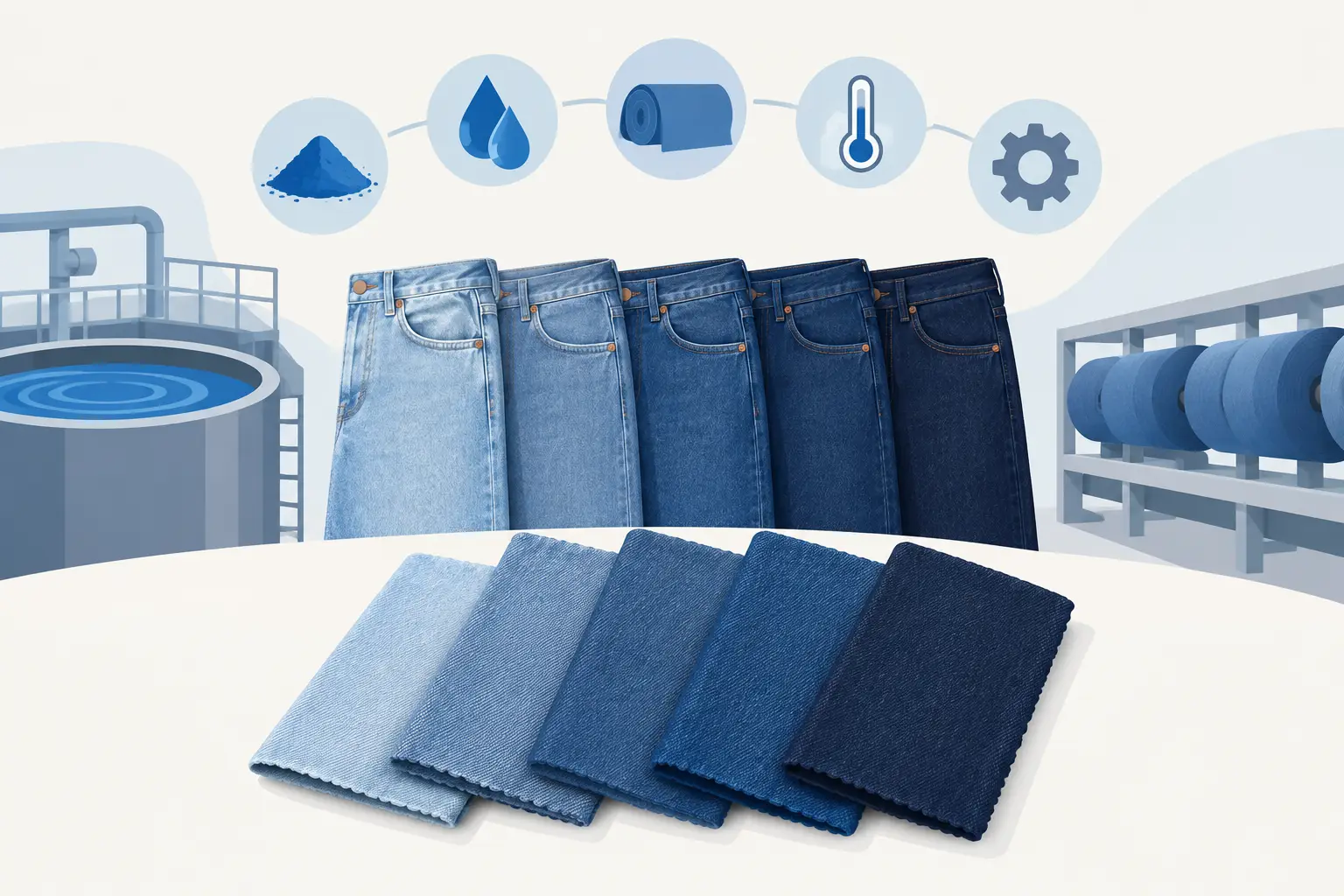
A shade mismatch is easy to miss on a cutting table and hard to ignore once a collection reaches the sales floor. When one pair of jeans looks noticeably bluer, darker, or greyer than another carrying the same style number, buyers may question the entire program. Understanding what causes denim shade variation helps brands set realistic standards, write better specifications, and prevent avoidable claims before bulk shipment.
Denim is not a flat, uniformly dyed fabric. Its character comes from indigo yarns, woven construction, wash effects, abrasion, and finishing. Those same variables make it more sensitive to process changes than many piece-dyed fabrics. A reliable manufacturer does not promise that every garment will be visually identical. It builds controls around approved standards, lot management, wash recipes, and inspection so variation remains within an agreed commercial tolerance.
What Causes Denim Shade Variation Across Bulk Orders?
Shade variation can begin before fabric reaches the garment factory, continue through sewing and washing, and become more visible under different lighting conditions. The key issue is whether variation is random and uncontrolled, or expected, measured, and kept within the brand’s approved range.
Indigo dyeing and yarn inconsistency
Traditional denim relies on ring-dyed warp yarns. Indigo sits primarily on the yarn surface rather than fully penetrating the fiber core, which creates denim’s familiar fading potential. Small shifts in dye concentration, oxidation time, dip sequence, yarn tension, and drying conditions can alter the initial cast of the fabric.
Even when mills use the same color name, two production lots may not read exactly alike. One roll may appear deeper blue, while another has a slightly greener or redder undertone. Sulfur bottoming, which is often used to create darker black-blue or cast effects, adds another source of variation if the dye application is not tightly controlled.
The practical control is lot continuity. For a single color program, fabric should be sourced from the same approved mill and, where possible, the same dye lot. If multiple lots are required, the manufacturer should compare them before cutting, group compatible rolls, and avoid mixing visibly different lots within one garment or delivery assortment.
Fabric construction, fiber content, and surface texture
Two fabrics can carry similar indigo shades but wash differently because their construction is different. Yarn count, warp density, weave tension, fabric weight, and hairiness all affect how light reflects from the surface. A rigid 100% cotton denim will absorb and release wash effects differently from a stretch denim containing elastane, polyester, Tencel, or recycled fibers.
Fiber variability matters as well. Cotton from different origins or crop conditions can have different absorbency and maturity. Recycled cotton introduces further variability because the feedstock is blended. These are valid materials for commercial denim, but they require more development testing and more realistic shade tolerances than a tightly controlled conventional cotton construction.
For brands, the lesson is simple: color approval cannot be separated from fabric approval. A wash recipe approved on one 12-ounce rigid denim should not be assumed to produce the same shade on a 10-ounce comfort-stretch fabric, even if both are described as mid-blue.
Roll-to-roll and side-to-center differences
Variation may occur within a single fabric roll. The edges and center can take dye or finishing differently, especially in wider fabrics or when process parameters drift. Roll-to-roll differences can also appear due to changes in mill production conditions, storage time, or finishing sequence.
Cutting-room discipline reduces the risk. Garment panels should be cut from compatible fabric rolls, and key visible components such as front legs, back legs, pockets, and waistbands should not be randomly combined from distant shade groups. For jackets and skirts with large panels, shade matching at the cutting stage is particularly important because the eye reads contrast across adjacent seams immediately.
Why Washing Creates the Most Visible Shade Change
Garment washing is where denim develops its final commercial identity, but it is also where minor upstream differences can become obvious. The same fabric may emerge light vintage blue, clean dark rinse, cast blue, or heavily contrasted depending on the wash sequence.
Enzyme treatments remove surface indigo and soften the fabric. Stone washing adds mechanical abrasion. Bleach or potassium permanganate processes can create localized fading, while ozone, laser, tinting, resin, and spray applications add further visual layers. Water temperature, liquor ratio, machine loading, treatment time, chemical concentration, and operator execution all influence the final shade.
A wash that looks stable in a small sample machine may shift in bulk production. Larger industrial machines have different loading behavior and abrasion patterns. Garment density also matters: an overloaded machine may produce less abrasion and a darker result, while a low load can create stronger wash-down. This is why bulk wash approval should be tied to production-scale conditions whenever possible.
Garment construction affects wash results
Seam thickness, thread type, pocket shape, reinforcements, and panel layering affect how a garment abrades and retains dye. Heavier seams can create darker protected areas. Different thread colors may look more or less prominent after washing. A bartack, rivet, or folded hem can change water flow and abrasion around a specific area.
Designers often want pronounced highs and lows, whiskers, hand sanding, or vintage damage. These effects are inherently less uniform than a clean rinse wash. The trade-off is clear: the more handcrafted or destructive the aesthetic, the broader the acceptable garment-to-garment variation should be. That tolerance must be agreed during sampling, not debated after shipment.
Finishing, Drying, and Lighting Can Change Perception
Finishing steps can alter shade without changing the underlying dye level. Softeners may deepen the surface appearance. Tints can push a blue toward grey, green, or yellow. Resin treatments may create a coated or slightly darker visual effect. Heat setting and drying conditions can also shift the way a garment reflects light.
Then there is metamerism: two garments may look like a close match under factory lighting but different under daylight, retail LEDs, or warm home lighting. Denim is especially prone to this problem because indigo has a complex visual character and many washes include layered treatments.
Shade evaluation should therefore use a defined light source and an approved master standard. Brands should specify whether approval is based on daylight-equivalent lighting, cool white light, or another retail-relevant condition. A visual standard should be supported by a physical approved garment, fabric swatch, or wash panel, rather than a phone image or uncalibrated screen.
How Brands Can Control Denim Shade Variation
Control starts with clear decisions before development begins. The tech pack should identify the approved base fabric, target wash name, desired shade direction, contrast level, tint, and acceptable tolerance. Descriptions such as “medium vintage blue” are useful creatively but insufficient for production unless they are supported by a physical reference.
During sampling, brands should approve not only the best-looking sample but the acceptable range around it. A manufacturer can provide a shade band or wash range showing a lighter, target, and darker acceptable result. This approach is more practical than demanding an impossible zero-variation standard, particularly for enzyme, bleach, laser, or hand-finished styles.
For repeat programs, retain approved references from every season. The original garment, fabric lot information, wash formula, machine type, load quantity, and process notes become valuable production records. When a style is reordered six months later, the factory has an operational benchmark rather than relying on a general color description.
A disciplined bulk process includes incoming fabric inspection, lot segregation, pre-production wash testing, first-bulk approval, in-line checks, and final shade sorting. Shade sorting is not a substitute for process control, but it is an effective final safeguard. Garments can be grouped into compatible shades so one carton, store allocation, or customer order does not contain visibly inconsistent pieces.
Tuopu Apparel applies this type of development-to-bulk control because dependable denim production requires coordination between fabric sourcing, pattern development, sewing, washing, quality inspection, and shipment planning. For lower-MOQ launches as well as larger repeat orders, early approval of material and wash standards protects both speed and consistency.
Questions to Ask Before Placing a Denim Order
Before confirming bulk production, buyers should ask how fabric lots will be managed, whether the wash was developed on the final approved fabric, and what shade tolerance will be used during inspection. They should also confirm whether the production sample comes from bulk-representative machinery and whether final garments will be shade sorted before packing.
It is equally useful to clarify the intended retail presentation. If units will be displayed side by side in a premium store, the shade tolerance may need to be tighter than for a distressed capsule collection sold online. If replenishment orders are planned, reserve fabric or establish a repeatable mill specification early. Reproducing a wash months later is possible, but it is rarely identical without controlled records and a stable supply base.
The strongest denim programs treat shade as a managed production characteristic, not a last-minute defect category. When the aesthetic, acceptable range, and control points are defined before bulk cutting, natural denim character can remain visible without becoming a costly consistency problem.
No responses yet