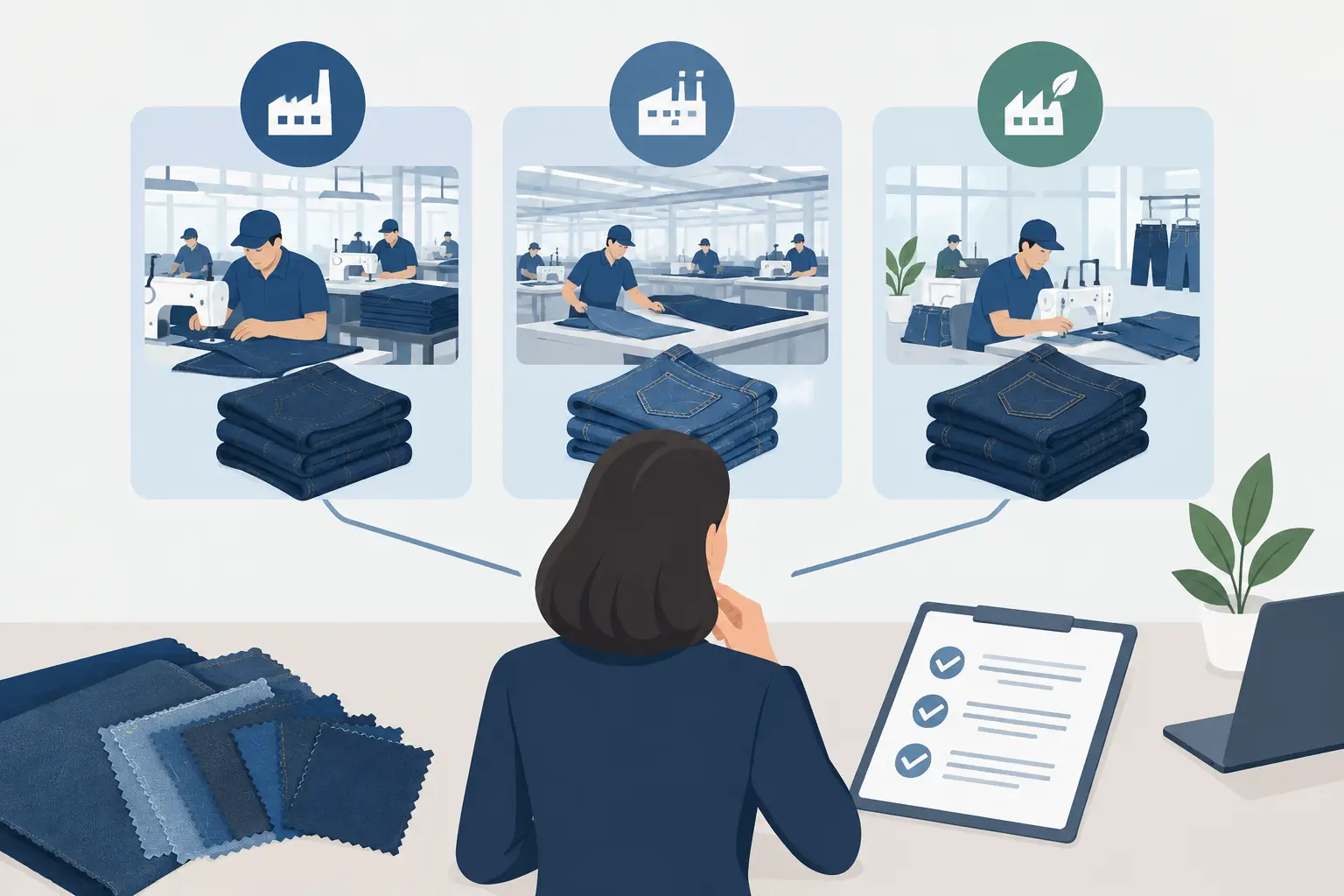
A CMT OEM comparison is most useful when a denim collection is ready to move from design intent to a production commitment. The choice affects more than unit price. It determines who owns fabric and trim sourcing, who manages material risk, how quickly samples can be approved, and how much internal supply chain capability your brand needs before placing an order.
For fashion brands, wholesalers, and retail buyers, CMT and OEM are not competing labels for the same service. They are different operating models. The right option depends on your product complexity, sourcing resources, volume plan, quality requirements, and tolerance for coordination risk.
What CMT Manufacturing Means
CMT stands for cut, make, and trim. Under a CMT arrangement, the buyer typically supplies the factory with the main fabric, lining, labels, hardware, and other required materials. The manufacturer cuts the materials, sews the garments, completes agreed trim work, and packs the finished goods according to the buyer’s specifications.
For denim, that can mean the brand sources its own denim fabric, pocketing, zippers, buttons, rivets, patches, woven labels, hangtags, and packaging. The factory then converts those approved materials into jeans, jackets, skirts, or shorts.
CMT gives an experienced buyer direct control over nominated mills and component suppliers. If a brand has developed an exclusive denim fabric, has negotiated fabric pricing at scale, or must use approved materials under a licensing agreement, CMT can be commercially logical. It also lets a sourcing team keep material purchasing separate from garment assembly.
That control comes with responsibility. The buyer must confirm fabric quality, manage shrinkage and shade variation, order adequate quantities, arrange delivery to the factory, and account for shortages. A sewing line cannot operate efficiently when a zipper shipment is late or when delivered denim fails inspection.
What OEM Manufacturing Means
OEM, or original equipment manufacturing, generally gives the factory broader responsibility for developing and producing the product to the buyer’s specifications. In an apparel program, the brand provides the design direction, tech pack, fit requirements, target price, branding details, and quality expectations. The manufacturer supports material sourcing, pattern work, sampling, production planning, bulk manufacturing, and quality control.
The exact scope should always be defined in writing. Some buyers use OEM to describe production from a finished tech pack. Others expect support with wash development, fabric recommendations, trim sourcing, grading, and packaging. In denim, those details materially affect cost, lead time, and the final garment.
A capable OEM denim manufacturer can manage the connection between fabric weight, stretch recovery, wash recipe, construction method, and final measurement. This matters because a jean that measures correctly before washing may change after enzyme wash, stone wash, tinting, distressing, or other finishing processes. Managing these dependencies in one production workflow reduces handoffs between suppliers.
CMT OEM Comparison: Control Versus Responsibility
The central CMT OEM comparison is not simply control versus convenience. It is control over inputs versus responsibility for outcomes.
| Buyer priority | CMT model | OEM model | | — | — | — | | Fabric and trim sourcing | Managed by the buyer | Managed by the manufacturer within the approved specification | | Supplier coordination | Buyer coordinates multiple vendors | Manufacturer coordinates its approved supply chain | | Material quality risk | Primarily buyer responsibility | Shared and defined through approvals and inspection procedures | | Product development support | Usually limited to production execution | Can include fabric, wash, pattern, and sample development | | Best fit | Brands with established sourcing infrastructure | Brands seeking an integrated development-to-delivery partner |
CMT can produce excellent results when the buyer has a strong sourcing office, proven material vendors, and a clear quality-control process. It is often practical for larger organizations that buy fabric centrally across several factories or that work with proprietary textiles.
OEM is usually more efficient for emerging labels and growth-stage brands that need to launch products without building a separate material sourcing operation. It is also useful when product development is still evolving. A manufacturer with denim specialization can recommend a fabric construction that supports the target fit and wash, rather than forcing a design onto an unsuitable material already purchased by the buyer.
Neither model removes the need for buyer approval. Under OEM, brands should still approve fabric swatches, lab dips, wash panels, trim samples, size sets, pre-production samples, and packaging details. The difference is that the factory manages the procurement and production execution behind those approvals.
Cost Is More Than the Factory Quote
A CMT quote may appear lower because fabric and trims are excluded. That does not automatically make CMT the lower-cost option. Buyers need to compare the full landed production cost, including material purchasing, freight to the factory, inspection, warehousing, shortage allowances, payment terms, and the time required to manage several suppliers.
CMT can reduce cost when a buyer has buying power with mills or already holds stock materials. However, it can become expensive when fabric is overordered, components arrive in incomplete quantities, or incompatible materials create rework. Denim presents a specific challenge because wash loss, fabric shrinkage, and yield must be calculated before bulk cutting. Underestimating any of these factors can lead to a material shortage late in production.
OEM pricing includes factory sourcing work and material management, but it can improve cost predictability. The manufacturer can calculate consumption based on the final pattern, account for expected wash behavior, and order materials according to the actual production plan. This is particularly valuable for smaller runs where a buyer cannot absorb large fabric minimums or leftover trim inventory.
When evaluating quotes, ask whether the price includes fabric, wash development, hardware, labels, testing, packing, export documentation, and inspection. A lower quote with undefined exclusions is not a dependable basis for supplier selection.
Lead Time and Sampling Differences
CMT lead times depend heavily on buyer readiness. If all approved materials are in the factory before production scheduling begins, CMT can move quickly. But each outside supplier creates another deadline. A late patch, incorrect zipper puller, or unapproved fabric shade can delay the entire order.
OEM can shorten the coordination cycle because the manufacturer works through an established supplier network and controls the sequence from material booking to cutting and washing. This does not mean every OEM program is faster. Custom fabric development, special hardware, complex wash effects, and repeated fit changes still require time.
For denim brands, sampling speed is often more valuable than a nominally short bulk lead time. Early samples reveal whether the rise, leg shape, pocket placement, wash contrast, and stretch behavior match the design intent. Tuopu Apparel supports sample lead times of approximately 10 to 15 days for applicable programs, helping buyers make decisions before committing to bulk materials.
The practical requirement is a disciplined approval process. Send complete tech packs, measurement charts, construction details, artwork, wash references, and packaging instructions. Consolidate feedback after each sample round. Fragmented approvals create delay under both CMT and OEM.
Quality Management in Each Model
CMT shifts more incoming-material responsibility to the buyer, but the factory should still inspect supplied fabric and trims before use. Buyers should agree in advance on how defects, shortages, shade variation, and rejected materials will be documented and handled. If the buyer-supplied fabric is defective, the sewing factory cannot correct that problem through workmanship alone.
In OEM production, the manufacturer should control incoming inspections, approved-material records, in-line checks, wash inspections, final measurement verification, and packing audits. For denim, quality control must consider more than stitching. It should verify wash consistency, color transfer risk, fabric skew, broken needles, hardware attachment strength, measurement tolerance after wash, and appearance standards for distressing or abrasion.
Ask every prospective partner where quality ownership begins and ends. A useful answer includes specific approval gates and records, not only a general promise of quality. This is especially relevant when a collection contains multiple washes or colors, since visual consistency must be managed across production lots.
Choosing the Right Production Model
Choose CMT when your company already has reliable fabric and trim suppliers, can manage material logistics, and needs direct control over proprietary or centrally sourced inputs. It is best suited to buyers with the staff and systems to prevent shortages before they reach the factory floor.
Choose OEM when you need a production partner to translate product requirements into an organized sourcing and manufacturing plan. For brands working with lower MOQs, seasonal capsules, new silhouettes, or wash-led denim collections, OEM can reduce the operational burden while keeping product approvals in the buyer’s hands.
Some businesses use both. They may run core jeans in CMT using contracted fabric programs while developing fashion washes, jackets, or limited drops through OEM. That hybrid approach can protect strategic material relationships without forcing every style into the same supply chain model.
The best decision is the one your team can control consistently. Before placing an order, map who owns every material, approval, inspection point, and delivery date. A clearly assigned production process will protect your margin and give your denim collection a stronger start in the market.
No responses yet