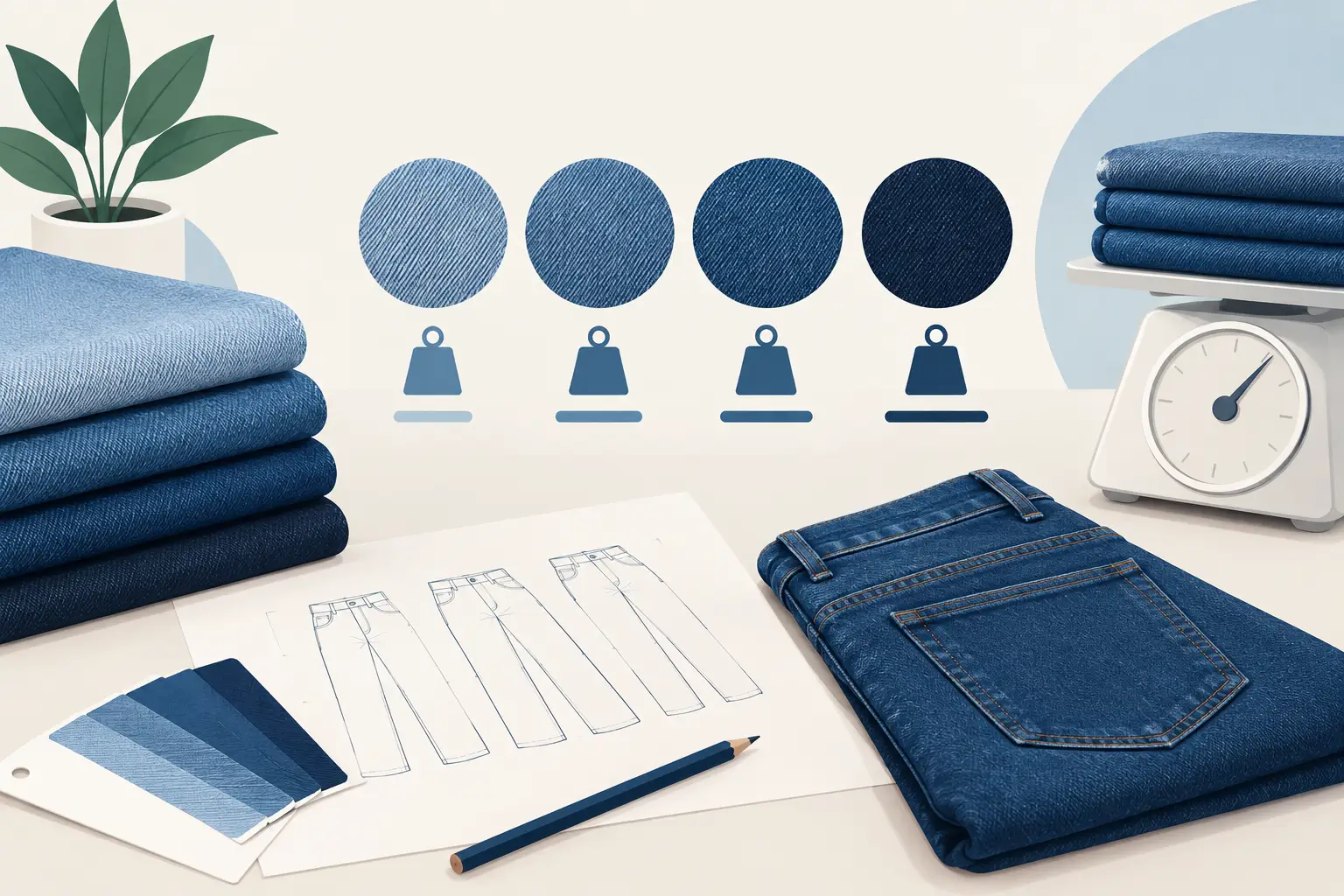
A denim specification can look right on paper and still fail at the sample stage because the fabric weight does not support the intended silhouette. This denim weight guide gives product developers and sourcing teams a practical way to select denim by ounces, then connect that choice to fit, wash performance, seasonality, cost, and production feasibility.
For a fashion brand, denim weight is not a minor fabric detail. It affects how a jean holds its leg shape, whether a jacket feels substantial, how aggressively a garment can be washed, and how customers perceive quality when they first pick it up. The right choice begins with the product’s commercial purpose, not a default ounce number.
Denim Weight Guide: What the Ounce Number Means
Denim weight is commonly measured in ounces per square yard, written as oz or oz/yd². A 12 oz denim is the weight of one square yard of fabric before it is cut and sewn. It does not mean the completed garment weighs 12 ounces.
The ounce number is useful, but it is only one part of the specification. A 12 oz rigid cotton denim can feel firmer and more structured than a 13 oz stretch denim because elastane, yarn count, weave density, finishing, and wash all change the final hand feel. Fabric mills may also state greige weight, which is the weight before washing and finishing, while a brand may evaluate the finished weight. Sourcing teams should confirm which measurement is being quoted before approving a fabric.
For consistency, request a fabric specification that states the finished weight, composition, usable width, weave construction, stretch percentage where applicable, and anticipated shrinkage. This avoids a common development issue: approving a swatch that feels correct, then receiving bulk fabric that behaves differently after finishing.
Common Denim Weights and Their Best Uses
Lightweight denim: under 10 oz
Lightweight denim usually falls between 4 oz and 9.5 oz. It is suited to denim shirts, chambray-inspired pieces, soft dresses, summer skirts, relaxed shorts, and layered fashion styles. At this range, the fabric drapes more easily and is more comfortable in warm weather.
It is not usually the best starting point for classic five-pocket jeans. The fabric can feel too soft at stress points and may not deliver the substantial look customers expect from traditional denim. Lightweight options work better when the design deliberately calls for fluidity rather than a rigid, heritage-jean appearance.
Midweight denim: 10 to 12.5 oz
Midweight denim is the most flexible range for commercial development. Around 10 oz to 11 oz, it works well for women’s jeans, shorts, skirts, overshirts, and lightweight denim jackets. At 11.5 oz to 12.5 oz, it can support a broad range of jeans and casual jackets while remaining comfortable for year-round wear.
This range is often a practical choice for emerging brands because it balances wearability, wash adaptability, shipping weight, and visual substance. Stretch denim in this category is particularly common for fitted silhouettes, including skinny, slim, flare, and body-contouring women’s styles. For men’s relaxed or straight fits, a rigid or low-stretch 12 oz fabric can provide a cleaner shape without becoming excessively heavy.
Standard heavyweight denim: 13 to 16 oz
Denim from 13 oz to 16 oz is the core range for durable jeans, structured trucker jackets, workwear-inspired styles, and premium rigid denim collections. It has more body, clearer seam definition, and stronger potential for pronounced fading and abrasion effects.
The trade-off is break-in time. A 14 oz rigid jean may feel firm at first, especially if it has minimal softening treatment. That is desirable for brands selling authentic raw, vintage, or utility-led denim, but it may create fit complaints for customers expecting immediate softness. Product descriptions, fit testing, and wash development should account for this expectation.
This weight range also requires careful pattern engineering. Thick seams, pocket stacks, belt loops, and waistband joins can become difficult to sew cleanly if construction details are not adjusted. A capable factory will select suitable needles, thread, stitch density, and seam allowances to maintain appearance and strength.
Heavy and specialty denim: over 16 oz
Denim above 16 oz is a specialty material. It is used for heritage workwear, raw selvedge programs, limited-edition jeans, and garments designed around extreme durability and a distinctive break-in experience. The visual and tactile impact can be powerful, but this is not an automatic premium upgrade.
Heavy denim costs more to handle and can slow sewing, washing, pressing, and packing. It also increases garment weight, which may affect freight costs and customer comfort. Before committing to 18 oz or heavier fabric, brands should confirm that their target customer understands and values the proposition. For a trend-focused capsule or broad seasonal assortment, a well-developed 12 oz to 14 oz denim may be the stronger commercial decision.
Match Weight to Fit, Stretch, and Garment Category
Weight should support the intended fit rather than compete with it. A wide-leg jean needs enough body to hold a strong leg line, while a close-fitting jean needs recovery and comfort as much as visual structure. Fabric composition determines how the same ounce weight performs in those situations.
For rigid straight, loose, barrel, carpenter, and wide-leg jeans, 12 oz to 14 oz cotton-rich denim is often effective. It creates definition through the hip and leg and responds well to enzyme, stone, bleach, and vintage wash treatments. For slim or skinny fits, 9.5 oz to 12 oz stretch denim may be more appropriate, provided recovery testing confirms that the knees and seat will not bag out after repeated wear.
Denim jackets generally benefit from 11 oz to 14 oz fabric. A lighter jacket is easier to layer and works well for spring collections, while a 13 oz or 14 oz version delivers the familiar structured trucker-jacket feel. Skirts and shorts have wider flexibility. A mini skirt can use 10 oz to 12 oz denim for comfort, while a utility skirt or long A-line style may need 12 oz to 13.5 oz to maintain shape.
Do not choose fabric weight based on a competitor’s garment alone. Two similar-looking jeans can use very different constructions. Compare the target fit, finished hand feel, composition, wash level, and intended retail positioning before setting the specification.
Washing Can Change the Weight and Hand Feel
A fabric’s pre-wash ounce weight is not the final customer experience. Washing removes sizing, relaxes fibers, changes color, and can alter both weight and density. A heavily processed vintage wash may feel softer and lighter than an unwashed sample made from the same base denim.
This matters when approving development samples. Brands should evaluate the actual wash standard, not only a mill hanger. If the collection requires strong sanding, whiskers, grinding, bleaching, resin, or coating, test those processes on the selected fabric early. Some denim constructions produce attractive highs and lows; others can become weak, overly flat, or inconsistent after aggressive treatment.
Shrinkage is equally important. Rigid cotton denim can shrink noticeably after washing, affecting inseam, rise, waist, and overall balance. Stretch fabrics also need testing because poor recovery can change fit after laundering. A reliable development process includes wash testing, measurement review, color assessment, and wear trials before bulk approval.
Questions to Ask Before You Approve Denim
Before confirming a fabric, product teams should be able to answer a few operational questions. Is the stated ounce weight finished or greige? Does the fabric have enough structure for the approved silhouette? Will the planned wash create the intended hand feel without weakening high-stress areas? Is the weight appropriate for the selling season and target retail price?
Also consider production details that are easy to overlook. Heavier fabric may require adjusted pocket construction, reinforced bartacks, stronger zipper specifications, and different packing methods. Lighter fabric may need stabilization in waistbands or plackets to prevent distortion. These decisions are most efficient when made during sampling rather than corrected after a bulk order is placed.
For brands running a new denim program, a controlled fabric library can speed future development. Keep approved swatches with finished weight, composition, wash formula, shrinkage result, color standard, and sample notes. Over time, this gives designers more freedom while allowing sourcing teams to repeat proven quality outcomes.
Tuopu Apparel supports this process from fabric sourcing and pattern development through sampling, wash approval, quality control, and bulk production. With a 300-piece MOQ and typical sample lead times of 10 to 15 days, brands can test the right weight and finish before committing to a larger seasonal order.
The most effective denim choice is the one that makes the garment perform as designed after washing, shipping, fitting, and repeated wear. Start with the silhouette, validate the fabric in its finished state, and let the ounce weight serve the product strategy rather than dictate it.
No responses yet