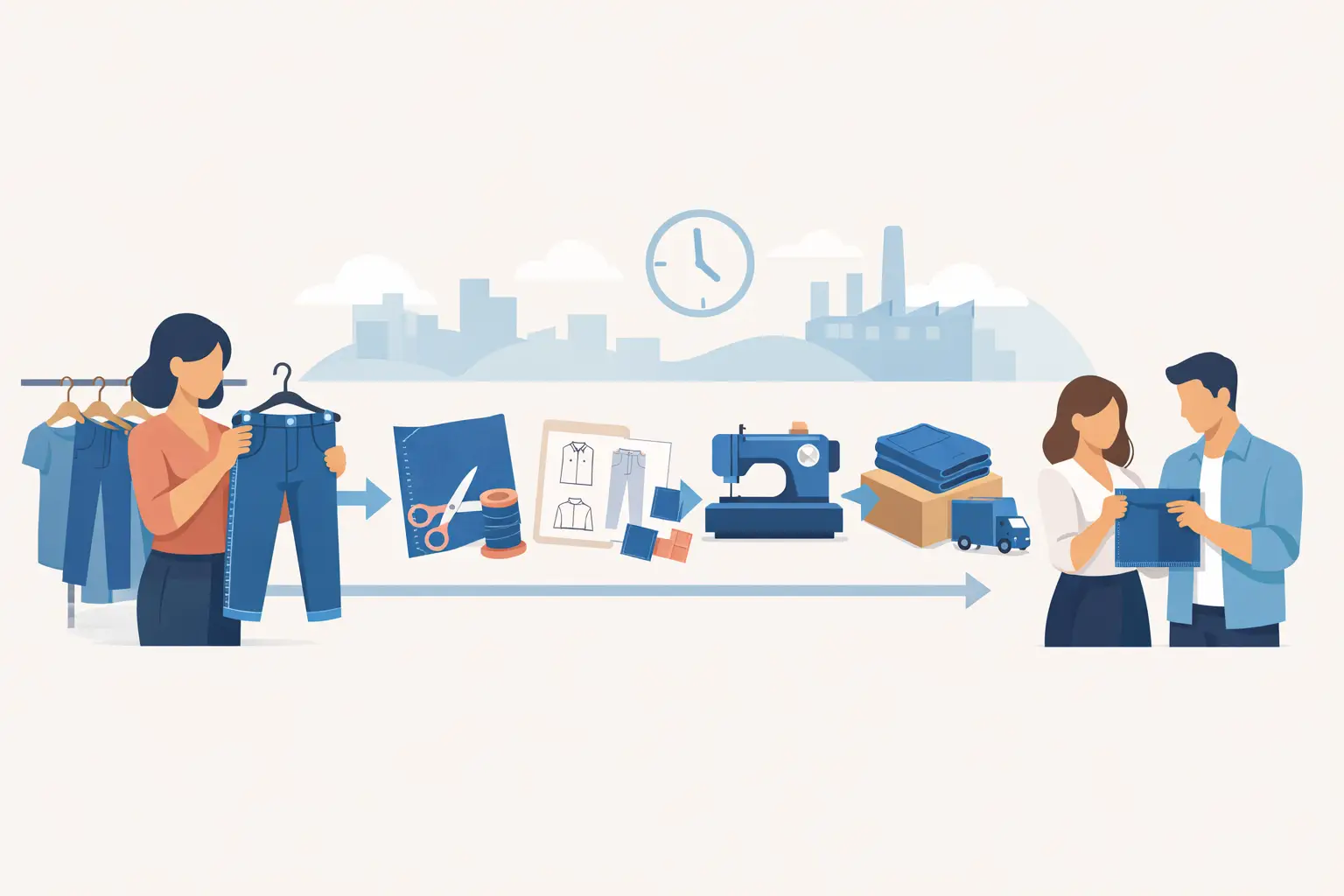
A denim sample can appear finished on a hanger and still be weeks away from bulk approval. The fit may be close, but the wash can change after production testing, trims may arrive late, or a revised pocket placement can require a pattern update. For brands working against seasonal delivery windows, sampling is not a single event. It is a controlled development sequence.
This guide to denim sampling timeline planning explains what happens between a design brief and bulk-ready approval, where delays usually occur, and how to set a schedule that protects both product quality and launch dates. For most custom denim programs, a first sample lead time of 10 to 15 days is achievable when the brief, materials, and wash direction are clear. The full development calendar depends on the number of revisions and the complexity of the garment.
Guide to Denim Sampling Timeline: The Core Stages
A practical denim sampling timeline starts before the factory cuts fabric. Development is faster when the brand and manufacturer agree on what must be approved at each stage: silhouette, measurements, construction, wash, trims, labeling, and final packaging requirements.
For a standard five-pocket jean or denim jacket, the process commonly follows this sequence:
| Stage | Typical Lead Time | Primary Output | | — | — | — | | Tech pack and material review | 1-3 days | Confirmed specifications and sourcing plan | | Pattern development and first sample | 10-15 days | Prototype for fit and design review | | Fit revision or second sample | 7-12 days | Updated pattern and construction | | Wash development and wash approval | 7-15 days | Approved color, hand feel, and effects | | Pre-production sample | 7-10 days | Bulk-standard reference sample | | Bulk production preparation | 3-7 days | Locked materials, approved standards, production plan |
These stages may overlap, but only when the development team has enough information to make controlled decisions. For example, a factory can source candidate denim fabrics while the pattern is being finalized. It should not commit to bulk wash formulas before the brand has approved the intended shade, abrasion level, and overall appearance.
Days 1-3: Confirm the Development Brief
The fastest sampling programs begin with a complete, commercially usable brief. A mood board alone can communicate direction, but it cannot establish production standards. The manufacturer needs a tech pack or clear working specifications that identify the garment category, fabric composition and weight, target fit, measurement chart, stitching details, hardware, labels, packaging, and target quantity.
Reference garments and wash images are particularly useful for denim. However, they should be treated as visual benchmarks rather than exact guarantees. A wash made on rigid 100% cotton denim will not reproduce identically on a stretch fabric, and the same wash formula can look different across fabric lots. The development team should identify which characteristics are non-negotiable, such as a dark indigo base, clean hem, vintage abrasion, or soft hand feel.
At this point, buyers should also confirm the sample size. A common approach is to develop in one base size, then grade the approved pattern for the full size range. If fit across multiple body types is central to the product, reviewing more than one size before bulk can reduce later risk.
Days 4-15: Pattern Making, Sourcing, and the First Sample
Once specifications are confirmed, the factory develops the pattern, sources or reserves the appropriate fabric and trims, and produces the first sample. This sample is designed to answer the most important early questions: Does the silhouette match the design intent? Are the rise, leg shape, sleeve shape, and proportions correct? Do construction details work in actual sewing conditions?
The first sample is not usually the final approval sample. It may use available substitute trims if custom buttons, patches, zipper pulls, or printed labels are still in development. That is acceptable when the purpose is fit evaluation, provided substitutions are clearly identified. If the placement or weight of a trim affects the garment, such as oversized metal hardware or a leather back patch, the final trim should be tested before pre-production approval.
Complexity changes the lead time. A basic straight-leg jean with standard pockets moves faster than a garment with panel construction, cargo pockets, embroidery, detachable elements, or custom hardware. Heavy distressing and specialized wash treatments also require more development time than a clean rinse wash.
Manage Revisions Without Losing the Calendar
The most common cause of sampling delays is not sewing capacity. It is unclear feedback. A comment such as “make the fit better” requires interpretation and can create another unnecessary round. Product teams should consolidate feedback internally before sending it to the factory, then provide measurable instructions wherever possible.
Instead of requesting a “slimmer leg,” specify the required change at the thigh, knee, and leg opening. Instead of asking for “less fading,” identify the areas to reduce, the desired contrast, and whether the concern is color loss or abrasion placement. Marked photos, measurement comments, and a single approved feedback file prevent conflicting instructions from different stakeholders.
A revision sample typically takes 7 to 12 days, depending on whether the factory is changing only the pattern or also reworking the wash and sourcing new trims. Brands should plan for at least one revision round for a new fit block. Two or more rounds may be appropriate for a new premium silhouette, performance stretch denim, or a style with detailed wash effects. The trade-off is straightforward: more refinement improves confidence, but each revision must be justified against the collection calendar.
Why Wash Approval Requires Its Own Time
Denim washing is both technical and variable. Enzyme treatments, stone effects, bleaching, tinting, hand sanding, whiskering, grinding, resin treatments, and garment dyeing can all change the final appearance and hand feel. Wash results also interact with the fabric’s fiber content, dye behavior, construction, and sewing thread.
For that reason, wash approval should not be treated as an afterthought. A brand may approve the garment fit while requesting several wash swatches or complete wash samples to compare color and treatment options. This can be efficient, but it requires clear priorities. If the exact vintage cast is the selling point of the collection, allocate additional time for wash trials. If speed is the priority, selecting a proven wash standard on a known fabric reduces uncertainty.
The approved wash sample should define the acceptable range, not only one perfect garment. Denim is intentionally processed, and minor garment-to-garment variation is normal. Before bulk production, the buyer and manufacturer should agree on acceptable shade variation, damage limits, placement tolerances, and hand-feel expectations.
The Pre-Production Sample Is the Bulk Standard
After fit, fabric, trims, and wash are approved, the manufacturer produces a pre-production sample, often called a PP sample. This is the final reference for bulk manufacturing. It should use the confirmed fabric, approved wash process, correct trims, labels, measurements, sewing methods, and packaging components.
A PP sample review is where operational details matter. Check inseam and outseam measurements after washing, pocket alignment, bartack placement, zipper performance, button security, stitching consistency, label content, care instructions, and carton or polybag requirements. If the product will be sold in the United States, labeling and compliance requirements should be built into the brief early rather than added after samples are complete.
Approval of the PP sample should trigger a production-ready package. The factory can lock material requirements, establish quality checkpoints, and schedule cutting, sewing, washing, finishing, inspection, and packing. At this stage, a 300-piece MOQ can give emerging brands the flexibility to test a new style without overcommitting inventory, while larger programs can move into scheduled capacity planning.
Build a Timeline Around Decisions, Not Just Dates
A reliable schedule includes both factory lead time and brand response time. A factory may complete a sample in 10 to 15 days, but a three-day delay in review, a week waiting for executive approval, or uncoordinated comments can quickly extend the calendar. Assign one final decision-maker and establish a review deadline before each sample ships.
For a new custom denim style, allow roughly four to eight weeks from complete brief to PP approval. The shorter end is realistic for a straightforward style using available materials and a proven wash. The longer end is more appropriate for custom fabrics, detailed finishing, multiple fit rounds, new hardware, or a highly specific wash target. Bulk production and freight should be planned separately after approval, based on order volume, production complexity, destination, and shipping method.
Tuopu Apparel supports this process with specialized denim development, 10-15 day sample lead times for well-defined projects, low-MOQ production from 300 pieces, and the capacity to scale approved programs into dependable bulk manufacturing.
The best next step is to set your launch date, work backward from the required delivery window, and reserve time for the decisions that cannot be rushed: fit, wash, and final bulk-standard approval. A clear brief and disciplined feedback process turn sampling from a source of uncertainty into a practical advantage for your collection.
No responses yet