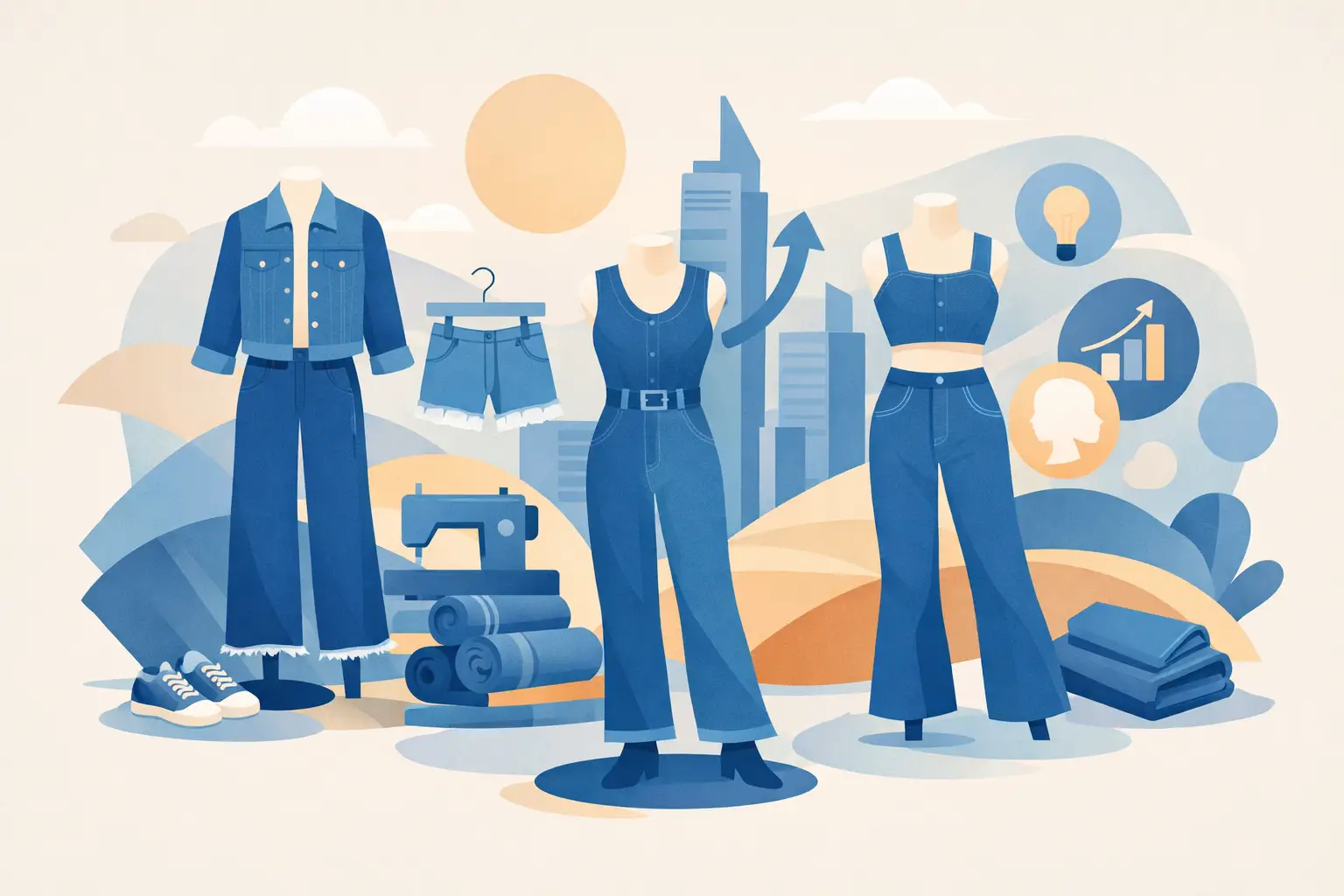
A denim collection can look current on a mood board and still fail at the sample stage. The strongest denim trends for fashion brands are not simply runway ideas. They are directions that can be translated into repeatable fits, controlled wash effects, reliable fabric sourcing, and margins that work at bulk scale. For 2026, buyers should focus on denim with a clear point of view, but avoid overbuilding collections around details that are expensive to reproduce or difficult to maintain consistently.
Denim Trends for Fashion Brands: What Is Moving the Market
The market is moving away from one dominant silhouette. Instead, consumers are building denim wardrobes around different occasions: relaxed jeans for everyday wear, more polished dark denim for going out, and statement pieces for social content and limited drops. This gives brands more room to create a focused assortment, but it also raises the cost of carrying too many low-volume styles.
The practical response is to develop a small number of core blocks and create variation through washes, lengths, pocket treatments, and hardware. A well-developed straight-leg block, for example, can support a clean rinse jean, a faded vintage wash, and a more directional panelled version without requiring three completely separate fit-development programs.
For product teams, the trend is not maximum novelty. It is controlled differentiation. The best commercial denim feels recognizable enough to sell quickly while offering enough design value to distinguish the brand from basic competitors.
Relaxed Fits Remain the Foundation
Relaxed straight-leg, loose-fit, and wide-leg jeans continue to provide the strongest base for contemporary denim programs. These silhouettes offer comfort and styling flexibility, and they work across men’s, women’s, and unisex collections. The key is proportion. A fit that is too oversized can become difficult to size, costly in fabric consumption, and less accessible to customers outside fashion-forward markets.
For women’s collections, relaxed straight jeans, full-length wide legs, and low-to-mid-rise loose fits remain relevant. Barrel legs and curved-seam shapes can add fashion interest, particularly in capsule collections, but need careful pattern engineering. The shape must hold after washing without creating unwanted twisting or volume at the knee.
For men’s and unisex lines, baggy carpenter-inspired jeans, relaxed 90s straight fits, and loose tapered silhouettes remain commercially useful. Utility details can support the story, but excessive pockets, straps, and heavy reinforcements increase sewing time and may limit repeat orders. Use those details selectively on higher-priced styles rather than across the full range.
Slim and skinny jeans are not absent from the market, but they are better treated as targeted replenishment products. Brands with established demand for these fits should maintain them, especially in dark, stretch, or polished washes. New brands should be cautious about making slim denim the center of a trend-led launch.
Length and break are now design decisions
Long inseams with a stacked break remain important for wide and loose denim, while cropped hems and ankle lengths suit cleaner straight-leg styles. This creates a development challenge: length changes affect the visual balance of the fit, placement of fading, and the final wash appearance.
Brands should approve inseam, hem opening, and break on a fit model before finalizing wash development. Altering length after wash approval often requires another sample round, particularly where destruction, hem abrasion, or laser placement is involved.
Dark Rinses and Vintage Fading Create Two Clear Wash Directions
Wash direction in 2026 is divided between refined dark denim and lived-in vintage character. Both can sit in the same collection when the assortment is organized around purpose rather than treated as a random mix of washes.
Dark indigo, clean rinse, black, and coated-looking finishes give brands a more elevated denim option. These washes work especially well in tailored jeans, denim shirts, structured jackets, and matching sets. They support a premium price position because the product looks intentional and versatile. However, dark washes demand disciplined color control. Inconsistent indigo tone, poor crocking performance, or uneven finishing will be immediately visible.
At the other end, sun-faded blues, greyed indigos, soft ecru, and authentic vintage washes continue to perform. The strongest results are not uniformly pale. They use restrained contrast, natural-looking whiskers, subtle seam abrasion, and fading that respects the garment’s construction. Overly aggressive grinding or artificial damage can make a product look dated quickly.
A wash recipe must be developed for repeatability, not only for one showroom sample. Fabric lot variation, garment weight, enzyme time, bleach concentration, and drying process all influence the final appearance. Brands should approve a clear wash standard with tolerances for shade, hand feel, abrasion level, and measurements after laundering.
Texture, Construction, and Surface Interest Matter More
Consumers are responding to denim that has tactile value. Rigid or low-stretch denim with visible twill character, slub texture, nep effects, and weighted handles can make familiar silhouettes feel more premium. This does not mean every product needs heavy fabric. Fabric selection should match the garment category and target customer.
A 100% cotton rigid denim can create strong shape and authentic aging, making it suitable for wide-leg jeans, trucker jackets, and workwear-inspired pieces. It may be less forgiving for close-fitting women’s styles or price-sensitive programs where return risk is a concern. Small amounts of comfort stretch can improve wearability while preserving a denim-like appearance, but stretch recovery must be tested after wash.
Construction details are also carrying more of the design message. Contrast topstitching, exposed button flies, reinforced belt loops, shaped back pockets, utility seams, and raw or released hems can differentiate a product without relying on extreme wash treatments. These details must be specified precisely in the tech pack. Thread color, stitch count, pocket placement, bartack position, and hardware finish are small decisions with large visual impact.
Denim Sets Are a Useful Commercial Opportunity
Coordinated denim jackets, overshirts, vests, skirts, and jeans remain valuable for brands looking to increase average order value and create stronger campaign imagery. The most effective sets do not require customers to wear every piece together. Each item should work independently while sharing fabric, wash, and trim language.
A dark indigo jean paired with a matching chore jacket can serve a contemporary premium customer. A faded oversized jacket with relaxed shorts may suit a younger seasonal offer. Matching sets also simplify fabric planning because multiple styles can be developed from one base denim. The trade-off is wash consistency. Garments with different seam density, panel size, and construction may take color differently even when processed together.
For this reason, each style should be approved individually, then reviewed as a group. A jacket should not be accepted simply because it matches a jean sample under one lighting condition.
Responsible Denim Needs Operational Proof
Sustainability claims remain commercially important, but buyers increasingly need evidence rather than broad statements. The most useful product decisions are measurable: selected fiber content, lower-impact wash processes where appropriate, reduced water or chemical inputs, recycled components, and durable construction that supports a longer garment life.
There is no universal sustainable denim formula. Recycled cotton can affect yarn strength and surface consistency. Organic cotton may involve different sourcing costs and lead times. Laser finishing and ozone treatments can reduce certain traditional wash steps, but they need to be matched to the intended look and available production process. A responsible product is one where the material, wash, quality standard, and claim can all be documented accurately.
Brands should discuss these choices early with their manufacturing partner. Changing fabric composition or wash method after sample approval can affect shrinkage, color, hand feel, and delivery timing.
Build Trend-Led Denim With a Production Plan
Trend relevance should be decided alongside MOQ, target cost, sampling schedule, and reorder potential. A fashion-forward sample that cannot be produced consistently within the target price is not a launch-ready product. This is particularly important for brands using limited drops, where a delayed sample or a failed wash approval can remove the selling window entirely.
Start development with a concise line plan: identify the core fit, intended fabric weight and composition, wash family, size range, target retail price, and expected order quantity. Then separate styles into core, seasonal, and statement categories. Core styles should receive the deepest fit and quality validation because they are the most likely candidates for reorders. Statement styles can carry more complexity, provided their margins justify the added development and sewing time.
Tuopu Apparel supports this process from fabric and pattern development through sampling, wash approval, bulk quality control, and global shipment. With a 300-piece MOQ and typical sample lead times of 10 to 15 days, brands can validate direction without committing to oversized inventory before demand is proven.
The best 2026 denim collections will not chase every new silhouette or finish. They will make disciplined choices, execute the details accurately, and leave enough production flexibility to respond when a promising style earns its next order.
No responses yet