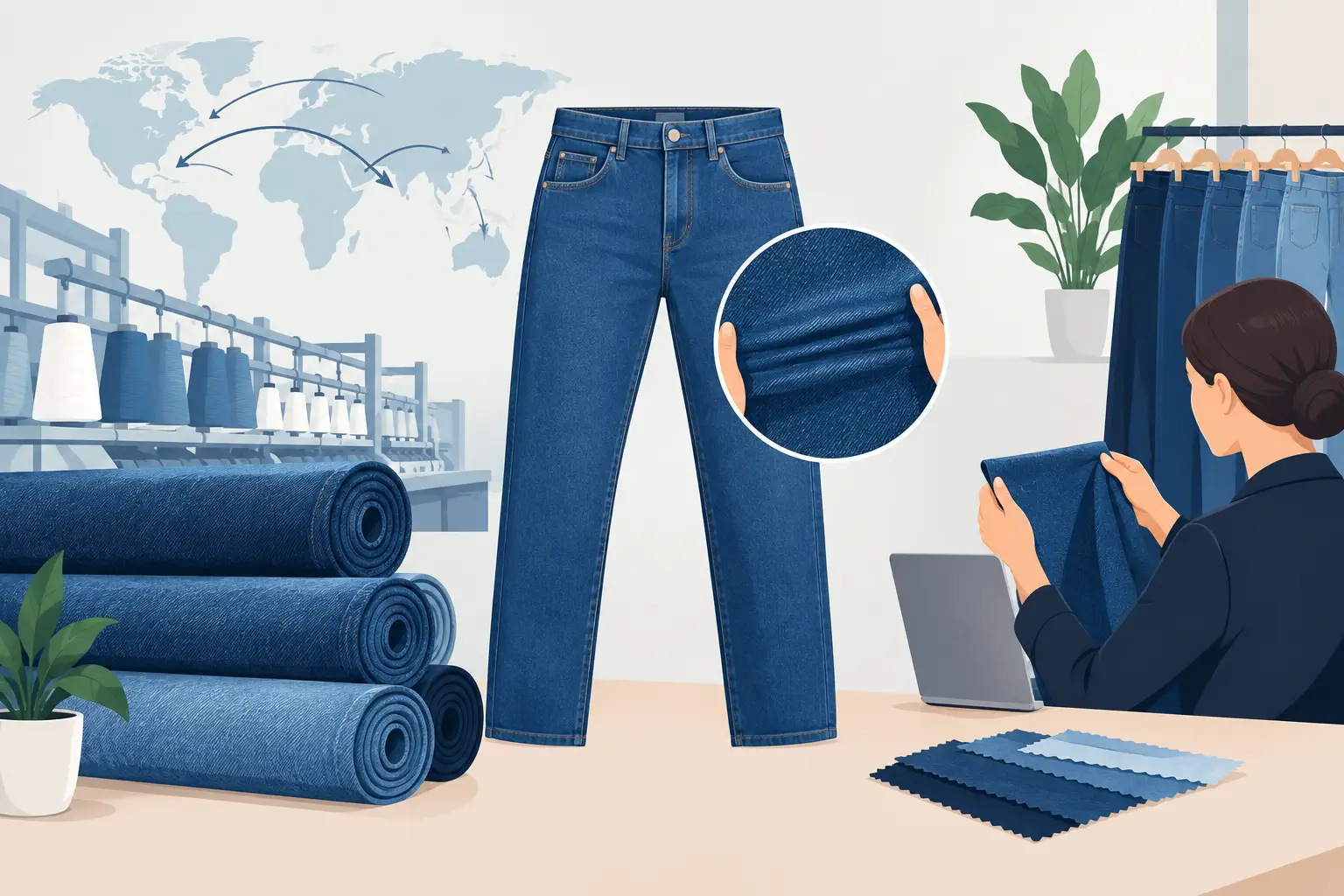
A stretch-denim program can look excellent in a first fitting and still fail after three wears. Waistbands can grow, knees can bag out, dark washes can lose shape after laundering, and a fabric that feels soft in the hand can create costly sewing issues on the production line. For brands learning how to source stretch denim, the objective is not simply to buy fabric with elastane. It is to specify a material system that delivers the intended silhouette, comfort, recovery, wash result, and repeatable bulk performance.
Start With the Garment, Not the Fabric Swatch
Stretch denim should be sourced against a defined product brief. A high-rise skinny jean, relaxed straight jean, fitted denim jacket, and stretch denim skirt may all use cotton-based fabrics with stretch, but they require different performance levels. Starting with a generic swatch book often leads to a fabric that is technically acceptable but commercially wrong for the fit.
Define the end use before requesting options. Confirm the target silhouette, desired body feel, seasonal weight, wash direction, size range, intended retail price, and expected wear conditions. A fashion-forward super-stretch jean may prioritize close fit and movement. A premium straight-leg style may need only comfort stretch, with a firmer authentic denim hand. For workwear-inspired styles, excessive stretch can weaken the visual structure customers expect.
The supplier should also know whether the garment will receive enzyme washing, bleaching, hand sanding, resin treatment, laser finishing, or heavy distressing. These processes can change stretch behavior, surface appearance, and shrinkage. Fabric cannot be selected independently from garment washing.
Understand the Stretch Denim Construction
Most stretch denim begins with cotton and adds an elastic component, usually elastane. The percentage alone does not tell the full story. Yarn construction, weave density, fabric weight, finishing, and the direction of stretch all influence how the material performs in a finished garment.
Comfort-stretch denim commonly uses a modest elastane content and is suited to straight, slim, relaxed, and structured silhouettes. It offers easier movement without looking overly elastic. High-stretch denim is engineered for body-contouring fits and usually needs stronger recovery control. Some constructions use dual-core or specialty stretch yarns to improve shape retention, reduce growth, or create a softer feel.
Ask whether the fabric has one-way or two-way stretch. One-way stretch typically supports traditional jeans construction and provides widthwise give across the body. Two-way stretch can improve mobility and fit in highly fitted styles, but it may require more careful pattern engineering and sewing control. It can also change how the garment reacts during washing and hanging.
Weight matters as much as stretch. Lightweight denim may work for summer shirts, skirts, and soft casual bottoms, but may not provide sufficient opacity or support for fitted jeans. Midweight denim is versatile for many contemporary jeans programs. Heavier weights create structure and durability, though they can feel restrictive if paired with insufficient stretch. The right choice depends on the desired hand feel and silhouette, not a universal ounce target.
Specify Recovery, Growth, and Shrinkage Early
Stretch is easy to demonstrate. Recovery is what protects the customer experience. A fabric with good recovery returns close to its original dimensions after extension, helping prevent baggy knees, loose seats, and stretched-out waistbands. This is especially critical for skinny, slim, and high-rise fits.
Request measurable test requirements rather than relying on descriptions such as “good stretch” or “high recovery.” Your development team and manufacturer should align on stretch percentage, recovery after repeated extension, growth after wear simulation, and dimensional change after washing. Test methods should be agreed before bulk approval so results can be compared consistently.
Shrinkage requires equal attention. Denim can shrink in length, width, or both after washing, and stretch constructions may react differently from rigid fabrics. The cuttable width, finished garment measurements, and wash shrinkage allowance must be built into the pattern and marker plan. If the shrinkage data is incomplete, the factory may be forced to correct fit late in sampling or, worse, during bulk production.
For a reliable sourcing package, provide target tolerances for garment measurements after wash. A capable denim manufacturer can then select fabric, adjust patterns, and validate the wash process against the same standard.
How to Source Stretch Denim Through Samples
A swatch approval is only the first filter. Stretch denim must be tested as a washed garment in the actual style, because sewing tension, pocket reinforcement, waistband construction, and wash treatment all affect the final fit.
Start with lab dips or fabric swatches to confirm color, hand feel, weight, and surface character. Then move quickly to a development sample using the intended fabric and trim package. The first sample should answer practical questions: Does the fabric support the intended shape? Does it recover after sitting and bending? Does it pucker at seams? Does the wash create unwanted streaking, abrasion marks, or elastane damage?
Fit samples should be evaluated on appropriate fit models across the relevant size range. A fabric that works in a sample size 4 may perform differently in extended sizes, where stress at the hip, thigh, and knee is greater. For size-inclusive programs, grading and recovery performance should be reviewed together rather than treated as separate approvals.
Before bulk production, approve a pre-production sample made with bulk-intended fabric and the confirmed wash recipe. This step is essential when the fabric has a dark indigo cast, coated finish, high-contrast wash, or heavy destruction. Small changes in fabric lot, wash chemistry, or processing time can materially affect the result.
Evaluate the Supplier Beyond the Fabric Offer
A mill can supply denim, while a garment factory can sew jeans. Sourcing becomes more controlled when the development and production partner can manage both material performance and garment execution. This reduces handoffs between parties that may interpret specifications differently.
Ask prospective suppliers how they control fabric inspection, shade continuity, lot allocation, and wash consistency. For stretch denim, also ask how they monitor relaxation before cutting, fabric skew, seam appearance, and measurement stability after wash. These are operational controls that directly affect the finished product.
A serious supplier discussion should cover the following:
- Available denim constructions, fiber blends, weights, and stretch directions
- Minimum order quantities by fabric and by finished style
- Sample lead times and whether development fabric matches future bulk supply
- Fabric and garment testing procedures, including recovery and wash shrinkage
- Wash capabilities for the required finish and environmental compliance requirements
- Bulk capacity, production scheduling, inspection standards, and export documentation
Low MOQ can be valuable for a capsule launch or new-market test, but it should not come at the cost of material traceability or repeatable quality. Likewise, a lower fabric price may create a higher total cost if recovery is weak, shade variation is difficult to control, or production delays require rework.
Build a Clear Technical Pack for Stretch Denim
The best fabric choice can still underperform if the technical pack is incomplete. Your supplier needs more than a garment image and target wash reference. Include the intended fabric composition, target weight, stretch direction, desired hand feel, construction details, measurement chart, grading rules, wash standard, trim specifications, labeling, packing requirements, and quality tolerances.
Call out areas where stretch behavior affects construction. Waistband stability, zipper fly shape, pocket opening distortion, belt-loop placement, inseam twisting, and hem growth should be reviewed during development. For highly fitted products, specify whether the garment should feel compressive, flexible, or relaxed after several hours of wear. Those words guide fabric and pattern decisions more effectively than a single stretch percentage.
It is also useful to define the order of approvals. Fabric quality, color, fit, wash, trim, packaging, and pre-production samples should each have a clear signoff point. This protects both the buyer and factory from late-stage changes that disrupt bulk timing.
Balance Cost, MOQ, and Long-Term Continuity
Stretch denim sourcing is a commercial decision as well as a technical one. Custom fabric development can provide a differentiated hand feel or performance profile, but it may require higher fabric minimums and longer lead times. Stock-supported bases can lower risk and accelerate sampling, though color and construction options may be more limited.
For an emerging brand, it can make sense to begin with a proven denim base, then customize the wash, pattern, trims, and branding. As volume grows, developing an exclusive fabric construction may become commercially justified. The right route depends on projected reorder volume, seasonal strategy, and how central denim is to the brand identity.
Tuopu Apparel supports this decision process through integrated denim development, 10-15 day sampling, flexible 300-piece MOQ programs, wash development, and bulk production capacity above 200,000 pieces per month. For buyers, the practical advantage is a tighter connection between fabric selection, fit validation, washing, and final delivery.
The strongest stretch-denim programs are built on evidence, not assumptions. Approve the fabric in the garment, test it after washing and wear, and choose partners that can explain how every material decision will hold up in bulk. That discipline gives your brand a better chance of delivering jeans customers reach for again, not jeans they replace after a few wears.
No responses yet