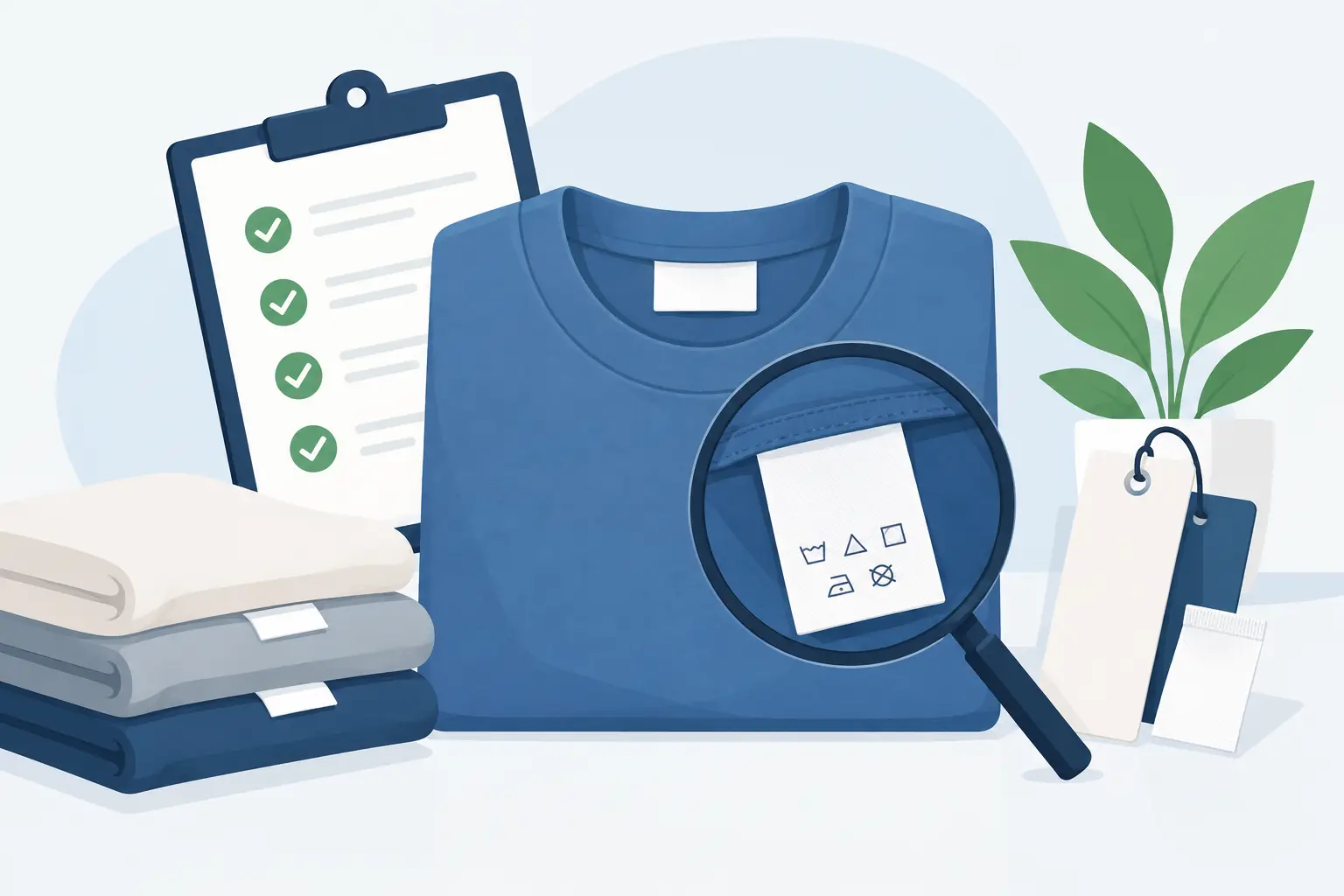
A denim collection can be well designed, correctly graded, and delivered on schedule, yet still create a costly problem at customs or retail review because the label information is incomplete. This guide to garment labeling requirements helps brands turn labeling into a controlled production specification, rather than a late-stage artwork task. For private-label denim, that means confirming required disclosures before sampling, approving physical labels before bulk cutting, and checking final placement during quality control.
Why Labeling Must Start Before Denim Sampling
Labels affect more than compliance. They influence neck and waistband construction, pocket-bag specifications, available sewing space, packaging, and the way a customer understands fit and care. If a brand changes a fiber blend after sample approval, for example, the fiber-content declaration may also need to change. The same is true when a supplier changes a pocket lining, adds a coated finish, or uses leather trim.
For denim, the production team should receive label copy alongside the tech pack. At minimum, the specification should state the brand name, size system, fiber composition, country-of-origin wording, care instructions, label dimensions, fold type, material, colors, placement, and required languages. Artwork alone is not enough. A woven main label, printed care label, heat-transfer label, hangtag, and carton sticker each serve different functions and are not interchangeable.
A hangtag can communicate fit, wash story, or sustainability claims, but it usually does not replace required permanent disclosures. Required information should remain available to the consumer after the hangtag is removed and after normal use and laundering.
Core Garment Labeling Requirements by Market
The correct label depends on where the garment will be sold, not simply where it is manufactured. A brand shipping the same jeans to the United States, Canada, and the European Union may need different language, identification, and composition formats. The following points are a practical planning framework, not a substitute for market-specific legal review.
United States
For most textile apparel sold in the United States, brands should plan for fiber-content disclosure, country-of-origin marking, and an identity for the responsible company. The company identity may be shown as a name or, where applicable, a registered identification number. Care instructions are also generally required for wearing apparel under U.S. care-labeling rules.
Fiber names and percentages must follow accepted terminology and reflect the finished product. A typical stretch jean might be labeled “98% Cotton, 2% Elastane.” If components have different fiber content, such as a cotton pocket bag or polyester lining, determine whether separate disclosure is required based on the applicable rule and product construction.
Country of origin must be accurate. For imported jeans, “Made in China” is common when China is the correct origin under customs rules, but brands should not assume that final packing location or a minor finishing operation changes origin. Confirm origin with the manufacturer and customs adviser before approving label copy.
European Union and United Kingdom
The European Union requires textile fiber composition information using regulated fiber names. Information must be available in the official language or languages required by each destination market. If a product contains non-textile parts of animal origin, such as a leather waistband patch, the required statement must be considered as well.
Care symbols are widely expected by European consumers and retailers, even though care-label obligations can differ from fiber-composition rules and national requirements. Use established symbols only when the washing, drying, ironing, and dry-cleaning directions have been validated for the finished garment.
The United Kingdom operates under its own post-Brexit framework. In practice, many brands use similar composition planning for EU and UK programs, but the legal details, language expectations, and importer information should be checked for the specific sales channel.
Canada, Australia, and Other Export Markets
Canada commonly requires textile fiber content and dealer identification, with bilingual presentation requirements for consumer-facing information. Australia has mandatory care-labeling expectations for many textile products. Other markets may require local language, importer details, specific origin wording, or product registration.
The operational rule is simple: build a market matrix before bulk production. Identify each destination, retailer requirement, applicable language, mandatory disclosures, and label placement. A single global label can reduce complexity, but only when its wording meets every intended market. Otherwise, market-specific care labels or packaging variants may be the safer option.
Building a Label Pack That Works on the Production Floor
A complete label pack prevents costly interpretation during sampling and bulk sewing. It should distinguish permanent labels from removable marketing materials and assign each item a precise location.
For jeans, the main brand label may sit at the back waistband, while a care and content label is sewn into the side seam, waistband seam, or pocket bag. The best placement depends on the pattern, comfort expectations, retailer standards, and label size. A stiff label sewn into a sensitive side seam can create returns even when the legal information is correct.
Your label pack should include the approved copy in final capitalization and punctuation, vector artwork, label dimensions, base material, thread color, fold direction, seam allowance, placement measurement, and a reference photo or diagram. Also specify whether the label must be woven, printed, heat transferred, or made from recycled material. A claim such as “100% recycled polyester” requires evidence and should match the actual component being described.
Denim washes need particular attention. Enzyme washes, bleaching, resin finishes, and garment dyeing can affect label color, print legibility, shrinkage, and edge fraying. Test the label with the approved wash recipe, not only on an unwashed sample. A care label that becomes unreadable after stone washing is a production failure, even if the artwork was approved.
A Practical Approval Process for Denim Brands
The most efficient process has four controlled checkpoints:
- Confirm destination markets and required label disclosures during product development.
- Approve label artwork and physical swatches before the pre-production sample.
- Review placement, readability, and wash performance on the finished sample.
- Inspect label content and attachment during final quality control before shipment.
At Tuopu Apparel, this level of coordination is most effective when label files arrive with the tech pack before sample development. With sample lead times commonly targeted at 10 to 15 days and bulk programs starting from a 300-piece MOQ, early label decisions help prevent a small artwork change from becoming a production delay across an entire denim program.
For larger collections, keep a master compliance file for every style. It should record the approved bill of materials, fiber test results where relevant, origin decision, care method, label artwork version, target markets, and final inspection photos. This is especially useful when a bestseller returns in a new wash or a new factory source is introduced for a later season.
Common Labeling Failures That Create Avoidable Delays
The most common problem is treating the fiber declaration as a design detail. It is a factual claim tied to the bill of materials. A change from 1% to 2% elastane, a new lining fabric, or a switch from genuine leather to synthetic patch material can alter the correct wording.
Another frequent error is using inconsistent origin claims. The woven waistband patch may say one country, the care label another, and the hangtag may use vague language such as “Designed in USA.” Design origin is not manufacturing origin. Each statement should be accurate, non-misleading, and aligned with the brand’s customs and marketing position.
Care instructions can also be too generic. “Machine wash cold” may be incomplete if the garment should be washed inside out, washed separately because of indigo bleed, or not tumble dried due to shrinkage or trim damage. Denim brands should test care guidance against the actual wash, hardware, patch, print, and stretch recovery of the finished garment.
Finally, do not overlook legibility. Tiny type, low-contrast printing, excessive wash abrasion, and labels hidden in an impractical location can undermine an otherwise compliant program. Retailers may add their own standards for font size, placement, barcode labels, and packaging, so retailer manuals should be incorporated before production begins.
Final Checks Before Shipment
Before releasing bulk goods, compare randomly selected finished pieces against the approved label pack and bill of materials. Check fiber percentages, origin wording, care symbols or text, size accuracy, language versions, label orientation, stitch security, and readability after the approved wash. Confirm that the cartons and polybags, if used, match the retailer’s labeling and country-of-origin requirements as well.
The strongest labeling process is not the one with the most labels. It is the one where product development, sourcing, compliance, and factory execution work from the same verified information. When that control is built into sampling and pre-production, labels support a faster, more reliable route from denim concept to retail floor.
No responses yet