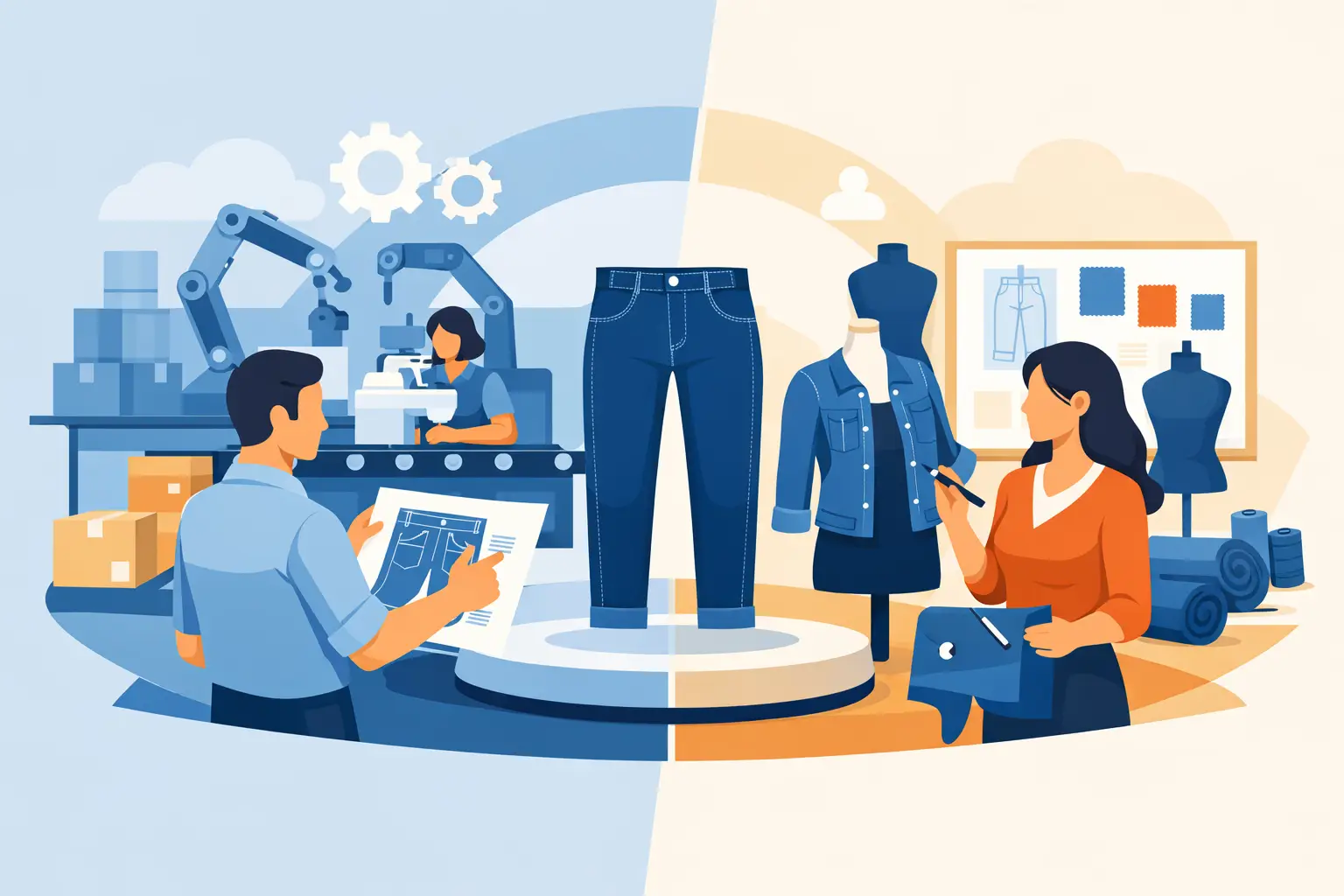
A new denim collection can fail before bulk production begins. The cause is often not fabric quality or factory capacity, but a mismatch between the brand’s development needs and the manufacturing model selected. An effective OEM ODM comparison helps buyers decide how much product control they need, how quickly they must launch, and where they can accept standardization without weakening their brand.
For denim brands, the decision has extra weight. Fit, wash character, fabric weight, trim selection, and construction details all affect how a product performs at retail. Choosing OEM or ODM is not simply a sourcing preference. It defines who owns the development work, how samples are created, what costs are involved, and how easily a program can scale.
OEM vs. ODM: The Core Difference
OEM means Original Equipment Manufacturing. In apparel, the brand provides the product direction and the manufacturer produces it to the brand’s specifications. Those specifications may include original tech packs, measurement charts, patterns, wash references, fabric requirements, branding details, packaging standards, and quality requirements.
ODM means Original Design Manufacturing. The manufacturer begins with existing product concepts, proven patterns, wash options, or development templates. The buyer selects and modifies a base product, then applies approved changes such as fabric, color, wash, trims, labels, embroidery, prints, or fit adjustments. The manufacturer carries more of the initial design and technical development responsibility.
The practical difference is control. OEM gives a brand greater control over a product’s original design. ODM gives the brand a faster route to a market-ready product platform. Neither model is automatically better. The right choice depends on the maturity of the brand, the complexity of the collection, launch timing, available development resources, and expected order volume.
OEM ODM Comparison: What Changes for Buyers
The table below shows where the two models differ during apparel development and production.
| Decision Area | OEM Manufacturing | ODM Manufacturing | | — | — | — | | Product concept | Created and defined by the buyer | Based on the manufacturer’s existing concepts or product library | | Design control | Highest level of control | Moderate control within an established product platform | | Development time | Longer, especially for new patterns and washes | Faster because core patterns and construction are already developed | | Upfront effort | Higher buyer involvement and more technical input required | Lower buyer workload during early development | | Product differentiation | Strong potential for proprietary products | Depends on the depth of customization applied | | Sampling | May require multiple rounds for fit, wash, and construction approval | Often moves faster from base sample to approval sample | | Best fit | Brands with defined product direction and long-term assortment plans | Brands testing categories, launching quickly, or working with lean teams |
This comparison is useful, but it should not be treated as a fixed rule. A capable denim manufacturer can support a hybrid approach. A buyer may start from a proven straight-leg jean block, for example, then develop a proprietary wash, revise the rise and leg opening, specify custom hardware, and add branded packaging. The project begins with ODM efficiency but moves closer to OEM-level differentiation.
When OEM Is the Better Choice
OEM is typically the stronger option when the product itself is central to the brand’s value. This is common for premium denim labels, fashion brands with a defined fit identity, and established retailers building exclusive private-label programs. If a customer recognizes your brand through a specific high-rise silhouette, a distinctive pocket shape, or a proprietary wash finish, the development process needs more control.
An OEM program usually starts with clear development documentation. The more complete the tech pack, measurement specification, bill of materials, and wash reference, the more accurately a factory can execute the product. In denim, the factory also needs to understand fabric composition, shrinkage expectations, garment dye or wash effects, stitch density, thread color, bartack placement, rivet finish, and label positioning.
OEM does require more buyer participation. Brands should expect to review fit samples, pre-production samples, wash panels, trim approvals, and size grading before releasing bulk production. That effort is justified when the product needs to be difficult to copy, consistent across seasons, and aligned with a defined brand standard.
The trade-off is time and development cost. Creating a new pattern block, sourcing a specialized fabric, or building a complex wash can require more sampling rounds. A supplier should be transparent about what is included in sample development, what changes trigger additional work, and how bulk pricing may change after final material and wash approvals.
When ODM Makes More Commercial Sense
ODM is often the practical choice when speed and inventory discipline matter more than building every garment from a blank page. Emerging labels, wholesalers, online retailers, and brands entering denim for the first time can use existing manufacturer capabilities to reduce development risk.
For example, a brand planning a seasonal denim shorts launch may select an existing block with tested fit proportions, then customize the fabric, wash, hem treatment, patch, woven label, and packaging. The end product remains branded and commercially relevant, but the buyer avoids paying for a fully new pattern and extended development cycle.
ODM also helps teams that do not have an in-house technical designer. A manufacturer with denim expertise can advise on realistic wash effects, fabric suitability, construction options, and fit adjustments before the sample stage. This reduces the risk of requesting a design that looks good in a reference image but cannot be produced consistently at the intended price point.
However, ODM should not mean accepting a generic product without scrutiny. Buyers still need to evaluate fit, fabric handfeel, wash consistency, workmanship, labeling, packing, and measurement tolerances. A base design may be proven, but it must still meet your market position and customer expectations.
Evaluate the Factory, Not Just the Model
The OEM or ODM label tells only part of the story. Manufacturing capability determines whether the selected model delivers a usable commercial result. For denim programs, buyers should assess the factory’s technical depth in pattern making, fabric sourcing, laundry development, sampling, production planning, and final inspection.
Ask how the supplier controls wash variation between samples and bulk units. Denim washing involves variables such as enzyme treatment, bleaching, abrasion, laser effects, hand sanding, dye behavior, and drying. A wash that appears correct on one sample can shift in shade or contrast when applied across a large production run. The supplier should have a clear approval process and production controls for maintaining the agreed standard.
MOQ is another operational factor. A factory that requires oversized commitments may make an OEM program impractical for a new collection. Flexible production partners can support smaller launches while maintaining a path to larger recurring orders. Tuopu Apparel supports development and production programs with a 300-piece MOQ, 10-15 day sample lead times, and capacity exceeding 200,000 pieces per month. That combination matters for buyers who need to test a style without limiting future scale.
Communication also affects both models. OEM projects need disciplined technical communication, version control, and approval records. ODM projects need clear confirmation of which elements are standard, which are customizable, and whether the selected materials will remain available for reorder programs. A reliable manufacturer documents these details before bulk production begins.
Cost, MOQ, and Margin Considerations
OEM can carry higher early-stage cost because the factory is developing patterns, testing materials, and refining wash or construction details. The unit price may also be higher if custom materials, specialty hardware, or low-volume production are involved. Yet a differentiated product can support stronger retail pricing and create better long-term brand value.
ODM generally lowers development expense and shortens the path to production. This can improve cash flow for a new launch, particularly when the buyer is testing demand. The lower initial cost should be balanced against potential overlap with other market products. Custom branding alone may not create enough distinction in a crowded denim category.
The best margin decision is not always the lowest factory price. Consider sample costs, development lead time, minimum order quantity, freight planning, defect risk, and the cost of holding slow-moving inventory. A slightly higher unit cost may be commercially smarter if it allows a smaller initial order, faster replenishment, and stronger quality consistency.
Choose Based on the Product Strategy
Choose OEM when your team has a clear product vision, technical specifications, and a reason to invest in proprietary fit, construction, or wash development. It is the right route when denim is a core expression of the brand and product differentiation will influence customer loyalty.
Choose ODM when you need a tested foundation, faster sampling, and lower development exposure. It is especially useful for capsule collections, trend-driven drops, category testing, and brands that need technical support without building a full internal product development department.
For many buyers, the most effective approach is phased. Start with an ODM base to validate fit and demand, then move successful styles into deeper OEM development as sales data and repeat orders justify the investment. The right manufacturing partner should support that progression with disciplined sampling, clear production standards, flexible MOQs, and the capacity to deliver the same denim quality when a small launch becomes a larger program.
The most useful decision is not whether OEM or ODM sounds more advanced. It is whether the model gives your team the right level of product control, financial flexibility, and production confidence for the collection you intend to sell.
No responses yet