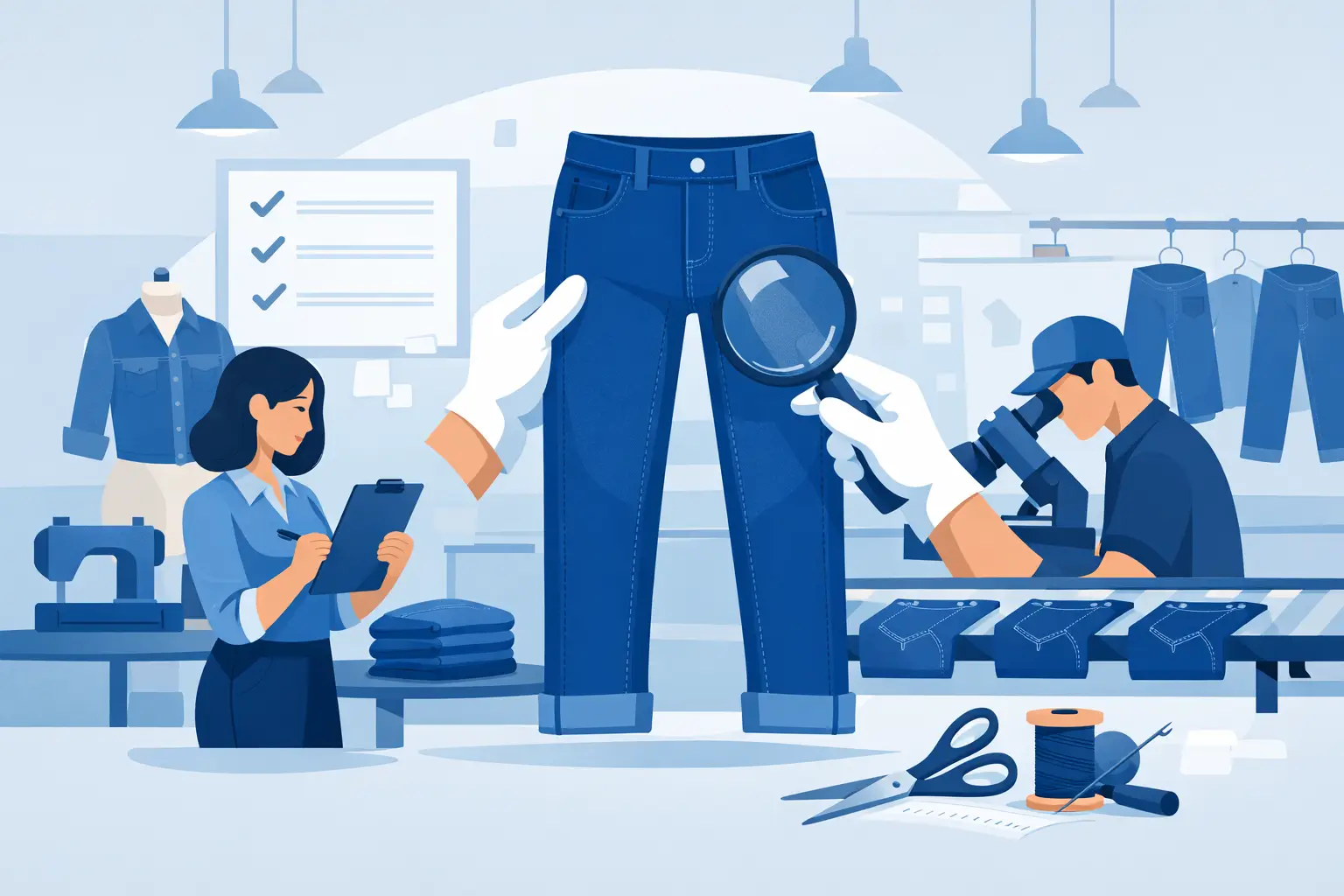
A denim quality control factory is rarely judged by what goes right. It is judged by what never reaches your warehouse – twisted legs, shade variation, broken stitching, failed measurements, and washes that look right on the salesman sample but drift in bulk production. For brands and sourcing teams, that difference is not minor. It affects margin, returns, retail confidence, and whether a reorder feels safe.
In denim manufacturing, quality control cannot be treated as a final checkpoint. It has to run through development, raw material approval, cutting, sewing, washing, finishing, packing, and shipment release. Denim is less forgiving than many casual categories because fabric behavior changes through wash processes, shrinkage has to be controlled, and small construction inconsistencies become obvious once a garment is worn.
What a denim quality control factory actually controls
A strong factory controls more than visible defects. The job is to maintain consistency between the approved sample and the production lot, even when thousands of pieces move through multiple operations. That means checking fabric weight, shade, recovery, pattern accuracy, seam construction, pocket placement, hardware performance, wash appearance, measurement tolerances, labeling, and carton accuracy.
For buyers, the real value is predictability. A denim jacket with a fashion wash may look simple on paper, but production can shift fast if the base fabric lot changes, if enzyme and stone wash results vary, or if finishing teams work from visual judgment instead of approved standards. Good quality control reduces that drift before it becomes a shipping problem.
This is also why denim QC has to be technical, not cosmetic. A garment can look acceptable on a packing table and still fail in wear testing, fit consistency, or post-wash measurement stability. Experienced teams know which issues are surface-level and which ones create claims later.
Quality control starts before sewing
The most expensive defects are usually the ones discovered too late. In denim, that often starts with fabric and trim approval. Before bulk production begins, the factory should confirm fabric composition, construction, shade continuity, width, shrinkage behavior, and wash suitability. A fabric that performs well in raw form may react differently after sanding, whiskering, enzyme wash, or resin treatment.
Trim control matters just as much. Rivets, buttons, zippers, labels, and threads all affect durability and brand presentation. If hardware color drifts from the approved standard or zippers fail during testing, the issue is not isolated. It can affect the full production run.
Pattern and pre-production review are another key stage. For denim jeans, small pattern issues can create repeated defects such as leg twist, poor rise balance, uneven pocket shape, or waistband mismatch. Once cutting starts, those problems scale quickly. A disciplined pre-production meeting aligns pattern, approved measurements, wash target, construction method, and packing requirements before volume is committed.
In-line control is where factories protect your order
The best denim quality control factory does not wait for finished garments to inspect quality. It checks production in line, while correction is still practical. This matters because denim production is sequential. If a stitching issue appears in early operations and goes unnoticed, it can affect hundreds or thousands of pieces before final inspection catches it.
In-line inspectors typically monitor cut panel accuracy, stitching density, seam strength, bartack placement, puckering, pocket alignment, fly construction, waistband attachment, and overall workmanship. For washed denim, they also track how garments are prepared before laundry, because inconsistent sewing or trimming can lead to uneven wash results.
The advantage for buyers is speed of correction. If measurements begin drifting outside tolerance or a machine setup causes seam irregularity, the line can be adjusted immediately. That protects both quality and delivery date. Without active in-line control, a factory may still find the problem later, but then the solution becomes rework, delay, or shipment compromise.
Why wash control is critical in denim production
Wash development is one of the biggest reasons denim needs specialized quality management. A pair of jeans can meet all sewing standards before laundry and still fail after washing. Shade can move, panels can distort, abrasion can become inconsistent, and finished measurements can shrink outside spec.
That is why wash approval should be based on clear standards, including hand feel, color tone, placement effect, damage level, recovery, and post-wash measurements. Bulk laundry also needs process discipline. Water ratio, chemical dosage, machine loading, treatment time, drying conditions, and finishing sequence all affect the final result.
For fashion brands, this is where specialization matters. General apparel factories may be able to sew denim, but wash control requires category-specific experience. If the target is a clean dark rinse, the risk is shade inconsistency and back-staining. If the target is a heavily processed vintage wash, the risk shifts to excessive damage, weak seam areas, and poor repeatability. A capable factory understands those trade-offs and manages them before production scales.
Final inspection should confirm, not discover
Final inspection remains essential, but it should be the last verification step, not the first serious review of quality. By the time finished goods reach final QC, the factory should already have confidence in workmanship, measurements, wash outcome, and packing accuracy.
A proper final inspection normally checks appearance, measurements, functionality, labeling, assortment ratio, packaging, metal detection if required, and carton condition. Inspectors compare production against approved standards and acceptable quality limits. They also confirm that size sets are balanced and that the shipment reflects the purchase order accurately.
For importers and retailers, this step protects against the simplest but most disruptive issues: wrong labels, mixed sizes, incorrect carton marks, missing hangtags, or assortments packed incorrectly. These are not technical failures, but they can still create warehouse delays and customer complaints.
What buyers should look for in a denim quality control factory
Not every factory defines quality control the same way. Some rely heavily on end-of-line inspection. Others build control into each production stage. For buyers placing custom denim orders, the difference is significant.
A reliable partner should be able to explain how standards are set, how approvals are documented, when inspections happen, and who has authority to stop or correct production. Transparency matters. If a factory cannot clearly explain its QC flow, the process is usually weaker than it appears.
Buyers should also assess whether the factory understands denim-specific risk points. Fit consistency, wash repeatability, hardware reliability, shade control, and shrinkage management are not side details. They are the factors that determine whether a bulk order is commercially usable.
Capacity is part of the quality conversation too. A factory that scales beyond its control system often becomes less consistent during peak periods. On the other hand, a manufacturer with experienced technical teams, stable washing capability, and structured inspection checkpoints can handle both lower-MOQ development runs and larger repeat orders with less variance. That balance matters for brands managing capsule launches, seasonal programs, and replenishment styles.
Process control supports speed, not just quality
Some buyers assume stricter quality control slows production. In practice, the opposite is often true. A factory with organized control points can move faster because fewer decisions are made in crisis mode. Samples are approved more clearly, bulk standards are easier to repeat, and problems are corrected before they stop the line.
This is especially important for brands working on compressed calendars. If you need rapid sample turnaround and dependable bulk delivery, the factory needs a control system that supports speed without creating hidden risk. That includes accurate pre-production alignment, timely in-line checks, wash monitoring, and shipment release procedures that do not rely on last-minute fixes.
At Tuopu Apparel, this is one reason denim production is managed as an integrated process rather than a set of disconnected departments. Development, sourcing, washing, bulk production, and inspection have to work from the same approved standard if the final shipment is going to match both the brief and the timeline.
The commercial impact of better QC
When denim quality control works properly, the result is not just fewer defects. It is a more stable buying process. Brands can approve samples with more confidence, place repeat orders with less hesitation, and plan inventory without building in excessive risk. That improves sell-through and reduces the hidden cost of rework, markdowns, claims, and delayed launches.
For sourcing managers, a factory’s quality system should be evaluated as part of commercial performance, not just compliance. Consistent quality supports margin. It protects product reputation. It makes growth more manageable when order volume increases.
The strongest manufacturing partners understand that denim QC is not there to impress an auditor. It is there to make sure the product arriving at your distribution center is the product you approved. That is what turns production capacity into something buyers can actually rely on.
If you are evaluating denim suppliers, ask fewer generic questions about quality and more specific ones about control points, wash consistency, and how problems are contained before shipment. The answers usually tell you exactly what kind of factory you are dealing with.
2 Responses
[…] Tuopu Apparel, wash development is integrated with fabric sourcing, pattern work, sampling, and bulk quality control. That connection helps identify issues such as shrinkage, color shift, or measurement movement […]
[…] OEM, or original equipment manufacturing, generally gives the factory broader responsibility for developing and producing the product to the buyer’s specifications. In an apparel program, the brand provides the design direction, tech pack, fit requirements, target price, branding details, and quality expectations. The manufacturer supports material sourcing, pattern work, sampling, production planning, bulk manufacturing, and quality control. […]