A denim jacket can look simple on a mood board and become very complicated the moment development starts. Fit, wash consistency, trim sourcing, panel alignment, and order minimums all affect whether your launch moves on schedule or stalls in sampling. That is why choosing the right custom denim jacket manufacturer is not a minor sourcing step. It is a product, margin, and timeline decision.
For brand owners and sourcing teams, the real question is not who can make a denim jacket. Many factories can. The question is who can develop your jacket accurately, control wash and construction at scale, and support the order volume you actually need. If your business runs seasonal drops, private label programs, or fast-turn capsule collections, the wrong factory creates delays, rejects, and rework that cost more than the quoted unit price ever suggests.
What a custom denim jacket manufacturer should actually provide
A capable manufacturer should do more than sew to spec. In denim, development support matters as much as sewing capacity because the final result depends on fabric behavior, pattern balance, wash execution, and finishing control. If the factory only offers cut-and-sew without strong denim development knowledge, the burden shifts back to your team.
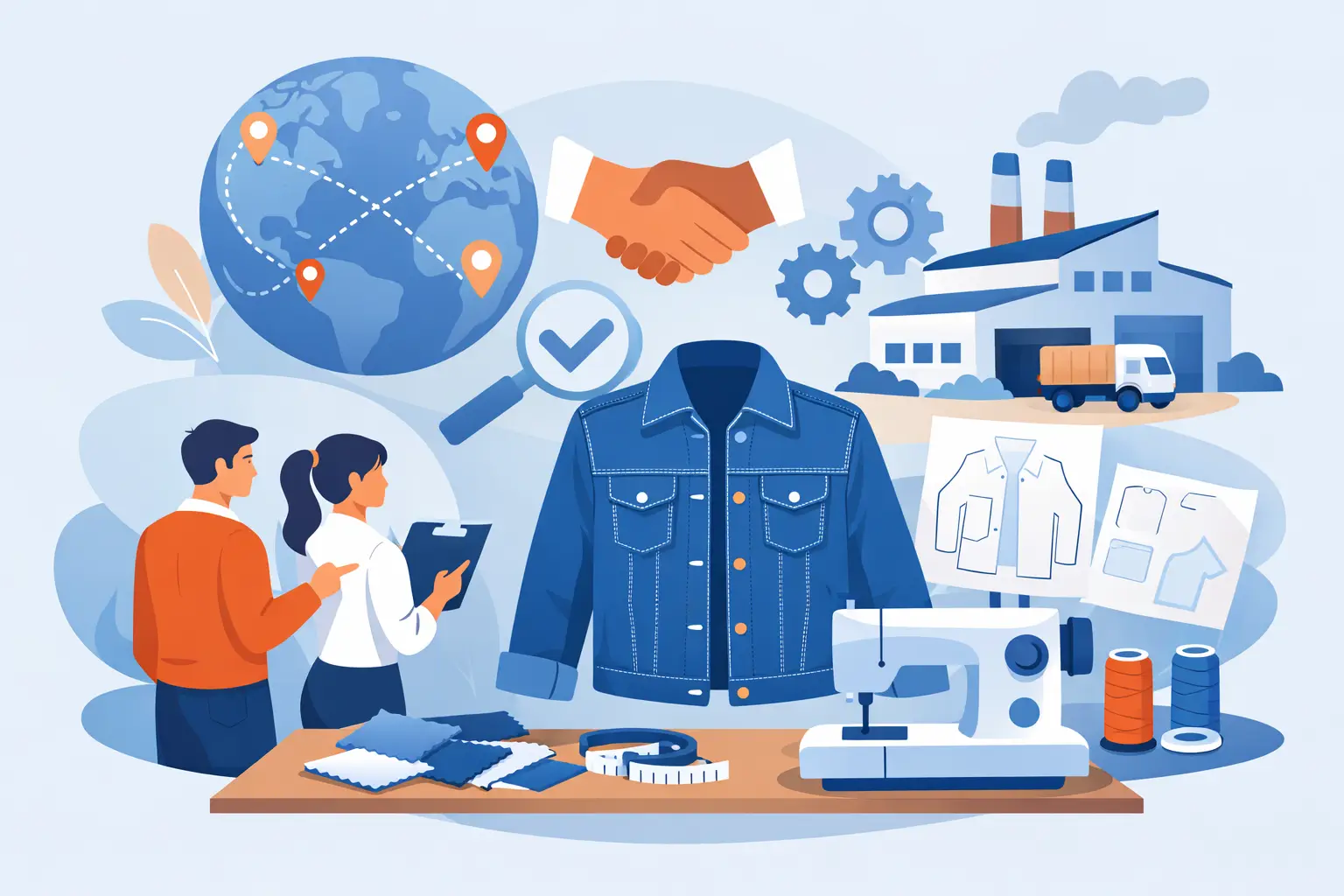
A strong custom denim jacket manufacturer should be able to support concept review, fabric and trim sourcing, pattern making, sample development, wash testing, size set approval, bulk production, quality control, and shipment coordination. That end-to-end structure reduces handoff errors. It also shortens communication loops when changes are needed after the first sample.
For buyers, this matters most when the design is not basic. Cropped silhouettes, oversized fits, panel jackets, garment-dyed styles, heavy destruction, vintage washes, contrast topstitching, and branded hardware all introduce variables. Each variable needs technical control before bulk starts.
Denim specialization matters more than general apparel capacity
A factory that produces many apparel categories is not automatically the right partner for denim outerwear. Denim jackets demand category-specific expertise. Fabric weight affects drape and sizing. Wash treatments can distort shape. Seams become highly visible after laundering. Hardware quality has a direct impact on both appearance and returns.
Specialized denim manufacturing teams understand these interactions early. They can flag whether your fabric choice is too rigid for the silhouette, whether your wash will create excessive shrinkage, or whether your pocket placement will shift after finishing. Those are not minor details. They determine whether your sample is commercially viable.
This is where experience has measurable value. A manufacturer with long-term denim production knowledge usually has stronger control over wash recipes, abrasion effects, fabric sourcing, and fit stability. That helps buyers avoid a common problem in denim production – a great-looking prototype that cannot be reproduced consistently in bulk.
Evaluate MOQ in relation to your business model
MOQ is often one of the first filters, and for good reason. If the manufacturer requires large opening volumes, emerging brands and test programs are boxed out before development even begins. But low MOQ alone should not be the deciding factor.
The better question is whether the MOQ aligns with your launch plan, SKU count, and replenishment strategy. A 300-piece MOQ can work well for a startup label testing two washes in one silhouette. It can also make sense for an established retailer piloting a regional program before scaling. What matters is whether the factory can keep quality stable at that lower volume while still offering competitive sourcing and finishing options.
There is a trade-off here. Extremely low MOQs may limit fabric choices, trim customization, or price efficiency. Buyers should ask what changes at different quantity levels. Sometimes increasing order volume slightly improves wash flexibility or hardware customization enough to justify the commitment.
Sampling speed is not just about speed
Fast sampling sounds attractive, but the real issue is usable sampling. A first sample delivered quickly but built from the wrong denim, with inaccurate fit and unfinished wash development, does not save time. It creates another round of revisions.
A reliable custom denim jacket manufacturer should be able to explain its sample process clearly. That includes lead time, development sequence, revision handling, and how approvals move into pre-production. A 10 to 15 day sample window is valuable when the technical work behind it is disciplined.
Buyers should also look at communication quality during sampling. Are comments interpreted correctly? Are alternative construction options suggested when a detail is inefficient or unstable? Does the factory identify risks before they become sample failures? Good sampling is a technical conversation, not an administrative transaction.
Wash capability can make or break the product
In denim jackets, wash is often the difference between a basic program and a saleable one. The same pattern can feel premium, commercial, fashion-forward, or low-grade depending on how the wash is executed. Whiskering, hand sanding, enzyme treatments, tinting, overdyes, vintage effects, and softening all need consistency from development through bulk.
This is one of the most important areas to verify during supplier selection. Ask for examples of previous wash ranges. Review how the factory handles shade control, hand feel, and repeatability across production lots. A manufacturer with premium wash capability can translate a design direction into a commercial finish without excessive trial and error.
There is also a practical side. More complex washes generally affect lead time, cost, and yield. If your target retail price is tight, the manufacturer should be able to recommend a wash approach that protects margin while keeping the visual identity of the style.
Quality control should be built into the process
Quality control is not a final inspection activity. In denim jacket production, quality has to be managed from raw material approval through cutting, sewing, washing, finishing, and packing. If QC happens only at the end, the factory is catching problems too late.
Professional buyers should ask how the manufacturer controls measurement tolerance, seam appearance, hardware attachment, wash consistency, labeling accuracy, and packing standards. A dependable production partner should also understand export packaging requirements and destination-market expectations.
The most common denim jacket failures are usually predictable: uneven wash tone, twisted seams, puckering, inaccurate chest measurements, poor button attachment, and inconsistent distress placement. A factory that already knows where those failures happen is more likely to prevent them.
Capacity matters, but so does production discipline
Large monthly output is useful, especially for brands planning scale, but capacity alone does not guarantee reliability. The question is whether the manufacturer can manage both development flexibility and bulk discipline. Some factories are efficient at large repeat orders but slow when styles require custom work. Others are good in sampling and unstable in bulk.
A strong partner should be able to support small and medium runs without losing control, then scale into larger programs as sell-through improves. That flexibility is especially valuable for DTC brands, wholesalers, and retailers managing demand uncertainty.
For example, a factory with denim specialization, low-MOQ support, and monthly capacity above 200,000 pieces can serve both launch-stage and established accounts if the internal process is organized correctly. That combination gives buyers room to test product without switching suppliers when reorder volume grows.
Export readiness is part of manufacturing performance
For international buyers, the factory relationship does not end at packed cartons. Documentation accuracy, shipment coordination, compliance awareness, and production visibility all affect whether goods arrive on time and clear smoothly.
An export-ready custom denim jacket manufacturer should be comfortable working with global buyers on labeling standards, carton markings, inspection procedures, and shipment schedules. This reduces the operational friction that often appears when a technically good factory lacks experience with overseas accounts.
It is also worth paying attention to responsiveness. A sourcing partner that communicates clearly on approvals, changes, and production status is easier to scale with than one that only reacts when problems surface.
What experienced buyers usually check before placing an order
Before moving into bulk, most experienced teams look for proof in a few specific areas: sample accuracy, wash consistency, MOQ flexibility, lead time reliability, and communication discipline. They also want to know whether the manufacturer can support product development, not just order execution.
That is why many buyers prefer partners with a specialized denim background and integrated services. Companies like Tuopu Apparel are structured around that model, combining OEM and ODM development, fast sampling, flexible MOQs, denim wash expertise, and bulk capacity in one workflow. For buyers managing timelines and margins, that kind of setup is easier to work with than splitting development across multiple vendors.
The best manufacturer for your brand is not always the cheapest or the largest. It is the one that can interpret your product correctly, produce it consistently, and support your growth stage without creating unnecessary complexity. If a supplier can do that, your denim jacket program starts with fewer assumptions and a much better chance of landing on schedule.
No responses yet