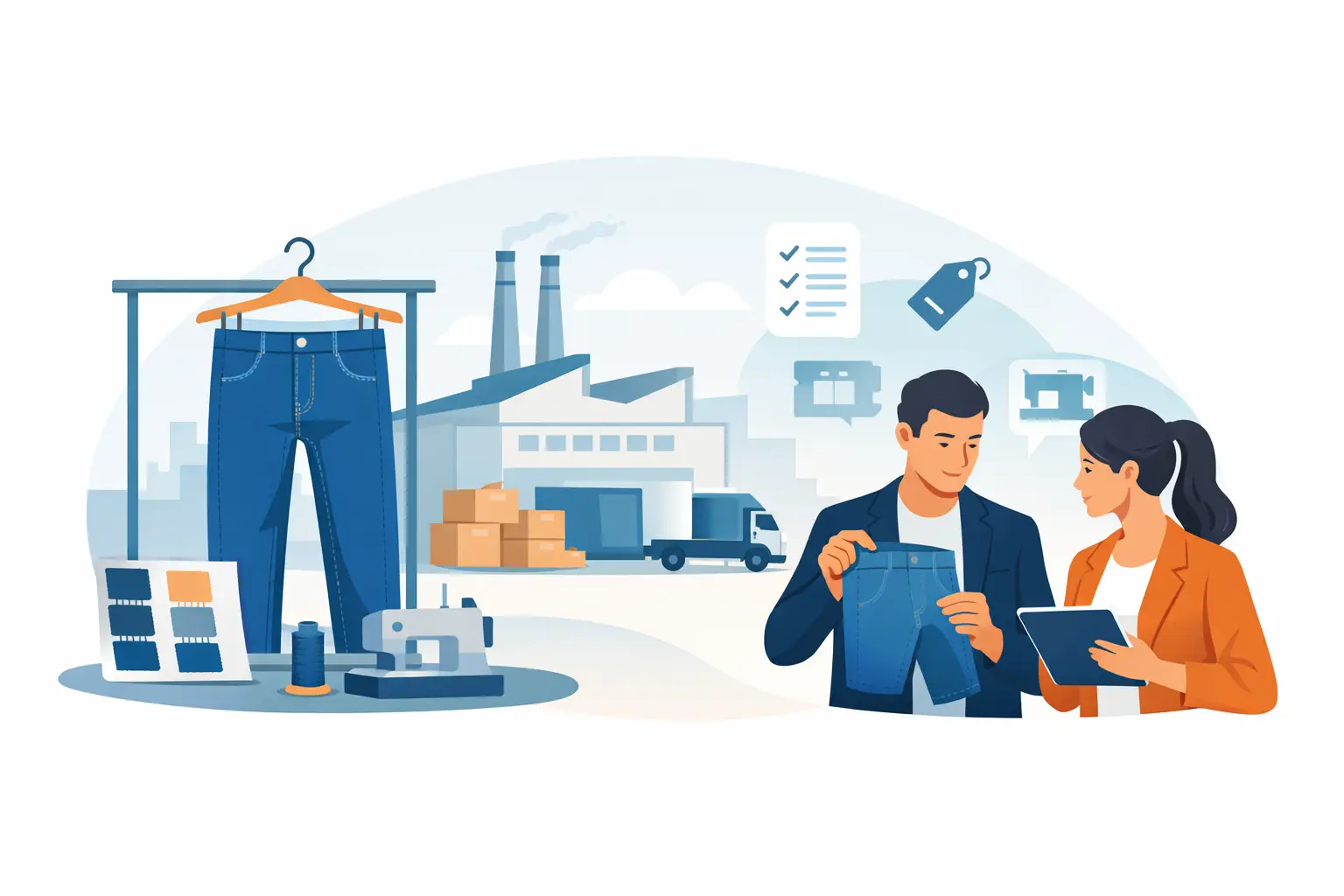
A missed denim season usually does not fail because of design. It fails because development takes too long, sample revisions drag, wash quality shifts between lots, or the factory cannot scale once orders land. That is why choosing the right private label jeans manufacturer is a commercial decision, not just a sourcing task.
For brand owners, sourcing managers, and product teams, jeans are one of the most technical categories in apparel. Fit tolerance, fabric behavior, wash execution, trim consistency, and production control all affect margin and sell-through. A supplier that handles basic cut-and-sew may not be equipped to manage denim at the level required for retail readiness. The right manufacturing partner should reduce risk at each stage, from concept and sampling to bulk production and shipment.
What a private label jeans manufacturer actually does
A private label jeans manufacturer produces denim products under your brand name rather than selling its own label. In practice, that can mean two different service models. In an OEM setup, the buyer provides detailed tech packs, measurements, artwork, and construction requirements, and the factory executes to spec. In an ODM model, the factory supports product development more actively, helping refine washes, fits, trims, and production methods based on a concept or reference sample.
For many buyers, the value is not simply that the factory can sew jeans. The value is that the manufacturer can translate a brand brief into a stable production program. That includes sourcing denim fabrics, developing patterns, making prototypes, adjusting fit, testing wash outcomes, managing bulk cutting and sewing, controlling quality, and preparing export shipments.
This matters more in denim than in simpler categories because small technical errors become visible quickly. A slight pattern issue can distort the leg shape. A wash inconsistency can change shade and hand feel across a run. Poor process control can affect shrinkage, puckering, seam appearance, and overall garment balance.
Why denim specialization matters
Not every apparel factory should be considered a strong jeans supplier. Denim requires category-specific experience. Fabric weights vary. Stretch recovery behaves differently by blend. Washes can alter measurements. Hardware installation affects both appearance and durability. A manufacturer that works deeply in denim is better positioned to predict and control these variables.
This is where specialization creates operational value. An experienced denim factory understands how to build around wash allowance, how different twills react in finishing, and how to maintain consistency across repeated orders. It can also guide brands on practical choices. Some fashion-driven details look strong in a sales sample but create instability in bulk. Other changes, such as adjusting pocket placement or rise proportions, can improve fit and reduce returns without changing the overall design direction.
For buyers launching a new denim line, this technical support is often the difference between a product that photographs well and a product that performs in market.
How to evaluate a private label jeans manufacturer
The first question is not price. It is process capability. If the factory cannot manage development cleanly, low unit pricing will not protect you from late launches, remakes, or rejected goods.
Start with sampling. Ask about lead times, revision handling, and the level of technical feedback provided during development. A factory with strong sampling discipline can usually identify construction risks early. Fast sample turnaround also matters commercially, especially for seasonal programs and trend-led capsule drops.
Then look at MOQ flexibility. Many brands need to test new fits, washes, or market segments without overcommitting inventory. A manufacturer with low MOQ capability gives buyers room to validate demand before scaling. This is especially useful for growing DTC labels, boutique retailers, and wholesalers balancing multiple style bets in one season.
Production capacity should be evaluated with equal care. Capacity is not just about large numbers on paper. It is about whether the supplier can maintain quality while increasing volume. A factory that can support small runs but struggles with consistency at scale may become a bottleneck once a style gains traction.
Wash capability is another critical point. Denim buyers should review what the factory can execute in terms of enzyme washes, vintage effects, abrasion details, tinting, overdyes, and specialty finishes. More importantly, ask how they maintain repeatability. Creative wash development is valuable, but repeatable bulk execution is what protects your brand.
The operational details buyers should not overlook
A strong jeans supplier should be able to discuss fabric sourcing, pattern control, trim coordination, and quality checkpoints with clarity. Vague answers usually signal weak systems.
Fabric sourcing affects both cost and performance. Different denim mills offer different strengths in weight, slub character, stretch content, color stability, and finish. The manufacturer should be able to recommend suitable fabric options based on your target price point and fit strategy. Premium fabric may improve hand feel and visual impact, but if it pushes the garment above your market ceiling, the choice may not be commercially sound.
Pattern making is equally important. Denim fit is sensitive. Rise, thigh, knee, and leg opening must work together, and grading has to reflect the intended customer. A factory that only copies existing samples without strong pattern expertise may replicate visible flaws rather than solve them.
Trim management often gets underestimated. Buttons, rivets, zippers, patches, labels, and hangtags all need to align with your brand positioning and compliance requirements. Delays or inconsistencies in trims can hold up bulk production just as easily as fabric issues can.
Quality control should cover more than final inspection. Effective manufacturers build checkpoints into the process – pre-production confirmation, inline inspection, wash approval, measurement review, and packing verification. That layered approach reduces surprises at the end of the order.
Speed matters, but controlled speed matters more
Many buyers ask for fast development because market windows are getting shorter. That is reasonable, but speed without process control creates expensive rework. The better standard is controlled speed.
A capable private label jeans manufacturer should be able to move from concept to sample quickly while still documenting specifications, approvals, and revisions. The same principle applies to bulk. Production should move efficiently, but not at the expense of measurement stability, wash consistency, or finishing quality.
This balance is especially valuable for brands managing frequent drops or compressed calendars. Rapid sampling in the 10 to 15 day range can accelerate decision-making, but only if the sample reflects realistic bulk execution. A beautiful prototype that cannot be reproduced in production is not a useful sample.
Low MOQ and scaling are not opposites
One of the biggest sourcing problems in denim is the gap between startup-friendly flexibility and dependable scale. Some suppliers accept low quantities but cannot support growth. Others have large capacity but require commitments that create inventory risk.
The best manufacturing partners are built to support both stages. They can help a buyer launch with a lower MOQ, validate a fit or wash program, and then scale into larger repeating orders once demand is proven. That model is more aligned with how modern apparel businesses operate.
For many brands, that flexibility is not a convenience. It is part of margin protection. Lower opening commitments reduce dead stock exposure, while reliable scale makes it easier to replenish winning styles without changing suppliers midstream.
Why end-to-end service reduces sourcing friction
Denim programs become harder to manage when development, sourcing, production, and logistics are split across too many vendors. Communication slows down. Accountability gets blurred. Problems take longer to trace and correct.
An end-to-end manufacturer can simplify that structure. When one supplier manages sourcing, pattern making, samples, bulk production, quality control, and shipment coordination, the buyer gains clearer visibility and faster response. This is especially useful for international customers who need export-ready execution and dependable communication across time zones.
That integrated model is one reason buyers work with specialized partners such as Tuopu Apparel. For brands that need denim expertise, low MOQ flexibility, fast sampling, and bulk reliability in one place, the operational value is straightforward.
The right choice depends on your growth stage
There is no single best factory for every buyer. A startup denim label may prioritize low MOQ, development support, and fit guidance. A larger retailer may care more about monthly output, compliance discipline, and on-time delivery across repeated programs. A fashion brand with aggressive wash direction may place wash development at the top of the list.
What does stay consistent is the need for a manufacturer that understands denim as a technical product and treats production as a controlled system. If your supplier can help you shorten development cycles, maintain wash and fit consistency, and scale without disrupting quality, you are not just buying manufacturing capacity. You are building a more stable denim business.
The best private label jeans manufacturer is the one that makes your next launch easier to execute and your next reorder easier to trust.
No responses yet