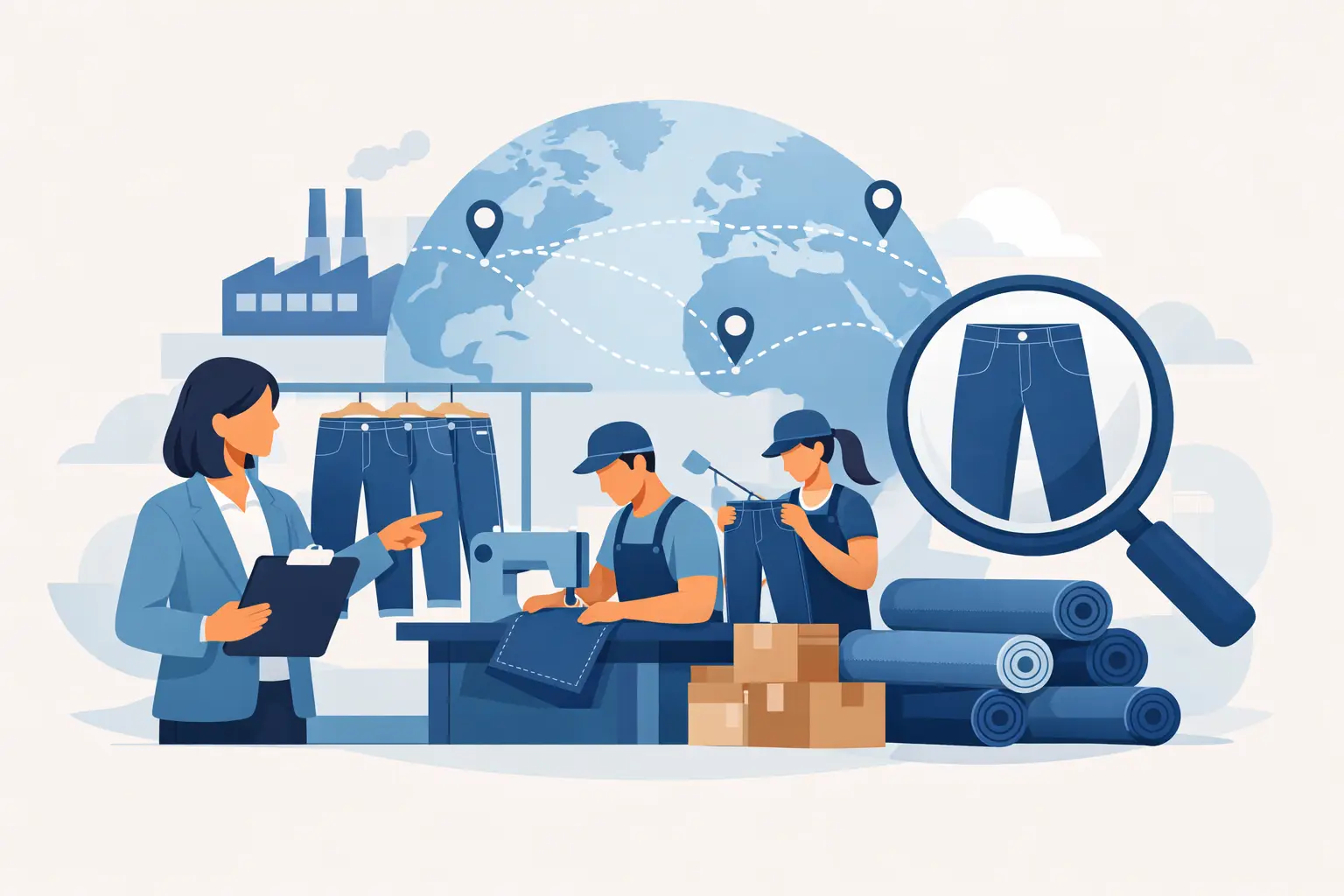
Launching denim with the wrong factory usually fails in one of two ways. You either get forced into order volumes that are too high for your forecast, or you accept a low minimum from a supplier that cannot hold quality, wash consistency, or delivery timing. A low MOQ denim manufacturer should solve both problems at the same time – giving you flexibility without creating production risk.
For fashion brands, sourcing teams, and private-label buyers, low MOQ is not just a pricing discussion. It affects cash flow, testability, speed to market, and how aggressively you can build a denim line. If you are developing a capsule collection, trialing a new fit, or entering a new market segment, the right manufacturing partner needs to support smaller runs while still operating with the discipline of a large-scale supplier.
What a low MOQ denim manufacturer should actually provide
Some suppliers advertise low minimums as a sales hook, but the operational reality is different. They may accept a small opening order, then raise costs sharply, limit wash options, reduce fabric choice, or treat the order as a low-priority job. That defeats the purpose.
A capable low MOQ denim manufacturer should have a process designed for smaller development runs and repeatable bulk production. That includes pattern development, sampling, material sourcing coordination, wash execution, fit correction, inline quality control, and export handling. If those functions are fragmented, low MOQ often becomes expensive in hidden ways through delays, rework, and inconsistent output.
This is especially true in denim. Jeans, jackets, skirts, and shorts are not basic cut-and-sew products. Denim production involves fabric weight decisions, shrinkage control, wash behavior, trim compatibility, fit balance, and construction durability. A factory can agree to 300 pieces, but if it cannot control leg twist, shade variation, or measurement tolerance after washing, the order is still a problem.
Why low MOQ matters for brand growth
For emerging and scaling brands, inventory pressure is one of the fastest ways to damage margins. High MOQs force broader commitments before demand is proven. That ties up capital in stock, increases markdown risk, and limits your ability to react to what actually sells.
A low MOQ denim manufacturer gives buyers more room to test. You can launch new rises, silhouettes, washes, or seasonal capsules without committing to oversized inventory. You can also divide buying plans more intelligently across styles instead of putting too much volume into one SKU just to satisfy a factory minimum.
This flexibility matters for larger businesses too. Not every production need is a mass-volume program. Retailers and wholesalers often need lower-volume development for market tests, account-specific capsules, regional assortments, or backup supply planning. In those cases, low MOQ is a commercial advantage, not a small-brand convenience.
The trade-off is straightforward. Lower volumes usually mean less economy of scale on fabric booking, washing, and trims. Unit prices can be higher. But for many buyers, that increase is more manageable than carrying excess inventory that may not convert.
How to evaluate a low MOQ denim manufacturer
The first question is not the MOQ number. It is whether the supplier has the systems to make a small order commercially viable and technically consistent.
Ask how sampling is handled. Fast sample turnaround matters because denim development often requires several revisions. A factory that can produce samples in 10 to 15 days gives your team a realistic path to fit correction and wash approval without derailing your calendar. Slow sampling usually creates rushed decisions later in production.
Then look at denim specialization. A general apparel supplier may offer jeans, but that is different from having real expertise in denim construction and washing. You want to know whether the factory regularly develops multiple denim categories, understands fabric behavior, and can execute a range of finishes from clean rinse washes to heavily processed fashion treatments.
Production capacity also matters, even when your first order is small. A factory with meaningful monthly capacity is generally better positioned to scale with you, maintain scheduling discipline, and support repeat programs. Small-batch flexibility is useful, but only if it sits inside a stable manufacturing system.
Quality control is another point where buyers should be precise. Ask how measurements are checked after wash, how shade consistency is monitored, and how defects are handled during inline and final inspection. Denim is one of the categories where a product can look correct before washing and fail after finishing. A manufacturer that understands this will talk about process control, not just final inspection.
Low MOQ does not mean low standards
One common sourcing mistake is assuming that low minimums belong only to lower-tier suppliers. In reality, the best low MOQ denim manufacturer is often the one that combines flexibility with mature factory discipline.
That means clear tech pack interpretation, reliable pattern execution, trim and fabric sourcing coordination, and structured communication through development and production. It also means understanding compliance, packaging requirements, labeling standards, and export documentation for international shipments.
For buyers in the US market, this is where supplier choice becomes practical. A factory may offer an attractive MOQ, but if approvals are poorly managed or shipment preparation is inconsistent, the total sourcing cost rises fast. Delays at the documentation stage, inconsistent carton marking, or preventable packing errors can create downstream problems that are much more expensive than a slightly higher FOB price.
A strong partner should reduce operational friction. That is the difference between a vendor and a manufacturing extension of your product team.
What to ask before placing an order
Before moving forward, buyers should confirm a few non-negotiable points. First, ask whether the MOQ applies per style, per wash, per color, or per size set. Some suppliers present a low number that becomes less attractive once those details are clarified.
Second, ask how fabric sourcing works at low volume. If the supplier depends entirely on large fabric bookings, your options may be narrow. A more experienced denim manufacturer will know how to balance stock fabrics, custom development, and practical alternatives based on your order size and timeline.
Third, ask about scaling. If your opening order performs well, can the supplier support larger repeat orders without changing construction quality or lead time discipline? Buyers do not want to re-source a successful style because the original factory was only suitable for development quantities.
Finally, ask who manages the process from sample approval to shipment. End-to-end coordination matters. When product development, sourcing, production, quality control, and logistics are disconnected, low MOQ orders become harder to manage because there is less volume to absorb mistakes.
The value of an end-to-end denim partner
The most efficient sourcing model is usually not the cheapest quote on paper. It is the supplier that can move from concept to bulk production with fewer handoff failures.
For denim programs, that includes reviewing your design intent, translating it into production-ready specifications, building patterns, making samples, sourcing the right fabric and trims, controlling wash outcomes, and keeping bulk production aligned with approved standards. When this happens under one coordinated system, buyers get better visibility and fewer surprises.
This is where an experienced manufacturer such as Tuopu Apparel can be relevant for brands that need both flexibility and scale. With over 20 years of denim experience, low-MOQ support starting from 300 pieces, sample lead times around 10 to 15 days, and bulk capacity above 200,000 pieces per month, the model fits buyers who need to launch carefully and reorder confidently.
That combination is useful because it supports both sides of the sourcing equation. You can start with disciplined inventory exposure, but you are not locked into a small factory that struggles when demand increases.
Choosing for the next order and the one after that
The best low MOQ denim manufacturer is not simply the one with the smallest minimum. It is the one that can help you test product with control, protect quality in small runs, and scale when the style proves itself.
That requires denim-specific technical ability, realistic lead times, process ownership, and commercial flexibility. It also requires honesty. Some programs are a good fit for low MOQ. Others need larger commitments to achieve the right fabric, wash, or price structure. A serious manufacturing partner will explain those trade-offs clearly instead of promising everything.
If you are sourcing denim for a new launch, a seasonal drop, or a developing private-label program, choose the supplier that makes smaller orders workable in real production conditions. That decision usually pays off long after the first PO is shipped.
4 Responses
[…] look at MOQ flexibility. Many brands need to test new fits, washes, or market segments without overcommitting inventory. A […]
[…] is a trade-off here. Extremely low MOQs may limit fabric choices, trim customization, or price efficiency. Buyers should ask what changes […]
[…] brands testing new fits, capsule launches, or seasonal fashion denim. A manufacturer that offers lower MOQs gives buyers more room to validate demand before scaling. That flexibility is especially useful for […]
[…] minimum order quantities also need practical review. A 300-piece MOQ can be commercially valuable for a capsule launch, but […]