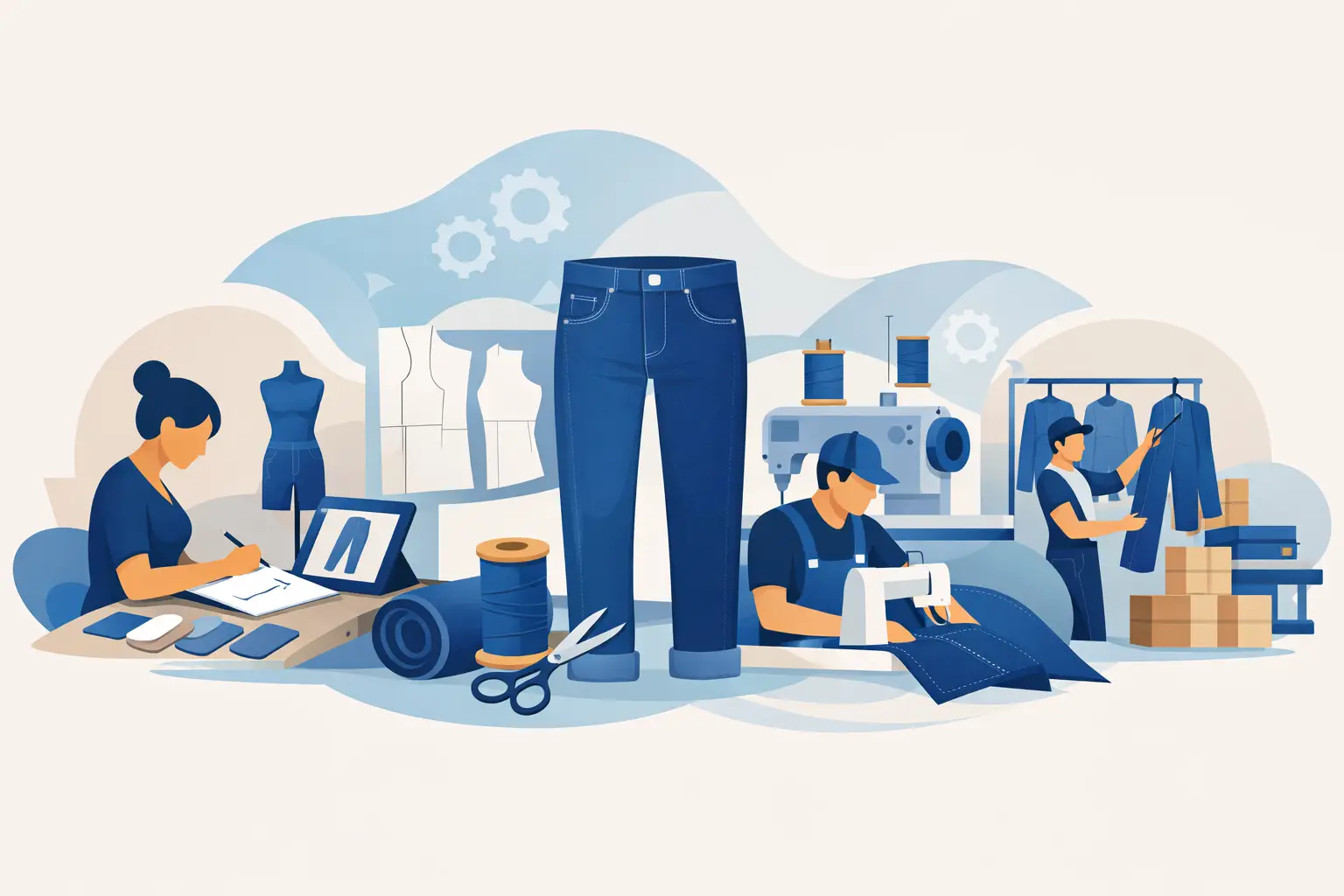
A successful denim launch is usually decided before the first pair of jeans reaches the sewing line. Fabric behavior, fit construction, wash development, trim selection, and approval timing all affect whether a style can be produced consistently at scale. The custom jeans manufacturing process turns a brand’s creative direction into repeatable, export-ready product – but only when development decisions are clear enough to control quality during bulk production.
For fashion brands, wholesalers, and retail buyers, the objective is not simply to create a good-looking sample. It is to build a specification that can deliver the same fit, wash character, and workmanship across every size and every production run.
1. Product Brief and Technical Development
The process begins with a detailed product brief. A factory needs more than a reference image to quote accurately and develop a workable sample. The brief should define the intended silhouette, target customer, price position, size range, planned order quantity, desired delivery window, and destination market.
A tech pack provides the production-level detail behind that brief. It typically includes flat sketches, measurements, construction notes, fabric requirements, wash references, trim placement, label artwork, packaging instructions, and grading expectations. If the tech pack is incomplete, the manufacturer can still support development, but the first sample may require more revisions.
For jeans, construction decisions have commercial consequences. A high-rise rigid wide-leg jean, for example, needs different pattern balance, fabric weight, seam allowance, and wash handling than a stretch skinny fit. Brands should also specify critical details early: front rise, back rise, thigh width, leg opening, inseam, pocket shape, yoke depth, waistband construction, fly type, and stitch color.
At this stage, the manufacturer reviews feasibility. The team confirms whether the requested fabric, wash effect, hardware, and construction are suitable for the target cost and production quantity. This review prevents a common problem: approving a visually attractive concept that cannot be reproduced reliably within the intended budget.
2. Denim Fabric and Trim Sourcing
Fabric selection is one of the most important decisions in the custom jeans manufacturing process because it affects fit, wash outcome, durability, and unit cost at the same time. Denim may be 100% cotton, cotton-elastane stretch denim, cotton-polyester blends, recycled-fiber denim, or specialty fabrics with coatings, slubs, or colored yarns.
Fabric weight is normally measured in ounces per square yard. Lighter denim can suit warm-weather collections and softer silhouettes, while heavier denim provides more structure and a more traditional rigid-jean feel. However, weight alone does not determine performance. Yarn count, weave density, stretch recovery, shrinkage, and dye quality all matter.
Before bulk production, fabric should be tested for key risks such as colorfastness, dimensional stability, skewing, tensile strength, and stretch recovery. This is particularly important for dark indigo, black denim, and heavily washed styles. A fabric that looks correct before washing can shift in shade, lose too much strength, or shrink beyond tolerance after finishing.
Trims are sourced alongside the fabric. These can include branded buttons, rivets, zipper tape, leather or jacron patches, woven labels, care labels, hangtags, and polybags. Custom hardware adds brand value, but it can also extend the development timeline. Buyers should confirm logo artwork, finish color, material, and testing requirements before placing trim orders.
3. Pattern Making, Grading, and Fit Sampling
Once the product direction is confirmed, the factory creates the pattern. This is the blueprint for every cut panel in the garment. Pattern makers translate design measurements into a shape that accounts for fabric stretch, shrinkage, sewing construction, and the changes created by washing.
Denim fit is not just a measurement exercise. A jean can match a measurement chart and still fit poorly if the hip curve, crotch shape, knee position, or leg balance is wrong. This is why fit sessions should assess the garment on a relevant fit model rather than relying only on flat measurements.
The first prototype verifies general construction and silhouette. After feedback, a fit sample is adjusted to refine the measurements, pocket placement, rise, waistband comfort, and overall balance. In many cases, two or more rounds are needed, especially for new brands developing a signature fit.
Grading follows once the base size is approved. Grading determines how measurements change from one size to the next. Poor grading can create garments that fit correctly only in the sample size. Brands should review graded specifications carefully, particularly for extended size ranges, where proportional adjustments often need more attention than standard straight-size grading.
4. Wash Development and Finishing Approval
Washing gives denim much of its identity. It can create softness, fading, contrast, vintage character, texture, or a clean dark finish. Common techniques include enzyme washing, stone washing, bleaching, tinting, garment dyeing, hand sanding, whiskering, laser finishing, and controlled distressing.
Wash development should be handled as a technical process, not only a visual one. The same wash formula can produce different results depending on fabric lot, garment construction, water conditions, and load size. Laser patterns or hand-applied abrasion must also be positioned consistently across sizes.
A wash sample allows the buyer to evaluate shade, fade level, softness, shrinkage, and distressing. It is useful to approve the sample against a signed wash standard or clear reference photos. The approval should identify what is acceptable and what is not, including color variation tolerance, damage limits, and placement of whiskers, grinding, or ripped areas.
There are trade-offs. Heavy distressing and complex multi-step washes create a more distinctive product, but they add labor, increase yield loss, and may lengthen production time. A cleaner wash with controlled finishing is often easier to scale and maintain across repeat orders.
5. Pre-Production Confirmation
Before cutting begins, the factory prepares a pre-production sample, often called a PP sample. This garment should reflect the approved bulk specification: final fabric, final trims, confirmed pattern, approved wash, labels, packaging, and workmanship standards.
The PP sample is the operational reference for the production team and the buyer. Approving it without checking the details can create avoidable bulk issues. Review the garment as if it were ready for retail sale. Confirm measurements after wash, button and rivet placement, stitching density, label information, care instructions, fold method, carton markings, and barcode requirements.
This is also the point to lock the production calendar. A dependable denim manufacturer will align fabric delivery, trim availability, cutting, sewing, washing capacity, inspection, packing, and shipment booking. Delays often come from late artwork approvals, missing trims, or fabric changes after sampling rather than from the sewing line itself.
6. Bulk Cutting, Sewing, and Wash Production
After PP approval, bulk fabric is inspected before cutting. The factory checks for shade variation, defects, width consistency, and shrinkage. Fabric rolls may be separated by shade bands to reduce visible differences within the same shipment.
Cut panels then move through sewing operations. Jeans production includes multiple controlled steps, such as pocket assembly, yoke joining, inseam and outseam sewing, fly construction, waistband attachment, belt loop application, hemming, bartacking, and hardware installation. Consistent stitch quality and accurate panel alignment matter because denim seams are highly visible.
Garments are usually washed after sewing. The wash department follows the approved formula and handling standard, then performs drying, pressing, repair work where needed, and finishing. Bulk wash output must be monitored throughout production, not only at the final inspection stage. Early checks help correct shade or shrinkage issues before they affect a full order.
Tuopu Apparel supports this integrated workflow with denim-focused development, 10-15 day sample lead times for many projects, and production flexibility starting from a 300-piece MOQ, depending on style and material requirements.
7. Quality Control, Packing, and Global Shipment
Quality control should occur at several points: incoming material inspection, in-line sewing checks, post-wash inspection, final measurement review, and packing inspection. Final inspection typically examines appearance, measurements, workmanship, function, labeling, and packing accuracy.
For jeans, inspectors pay close attention to uneven wash effects, broken stitches, skipped bartacks, loose rivets, zipper performance, uneven hems, twisted legs, incorrect labels, and measurement deviation after washing. A clear acceptable quality level and measurement tolerance should be agreed before production, particularly for retailer programs with strict compliance requirements.
After inspection, garments are folded, packed, and cartonized according to the buyer’s instructions. Export documentation, carton dimensions, shipping marks, and delivery terms should be confirmed early enough to avoid delays at the final stage. Whether the order moves by air for a launch deadline or by ocean freight for lower cost depends on volume, timing, and inventory strategy.
The strongest results come from treating every approval as a production decision, not a design formality. When fabric standards, fit comments, wash references, and packaging instructions are confirmed early, a manufacturer can move faster while protecting consistency. That gives your brand more control over the product customers receive – and more confidence when it is time to place the next denim order.
No responses yet