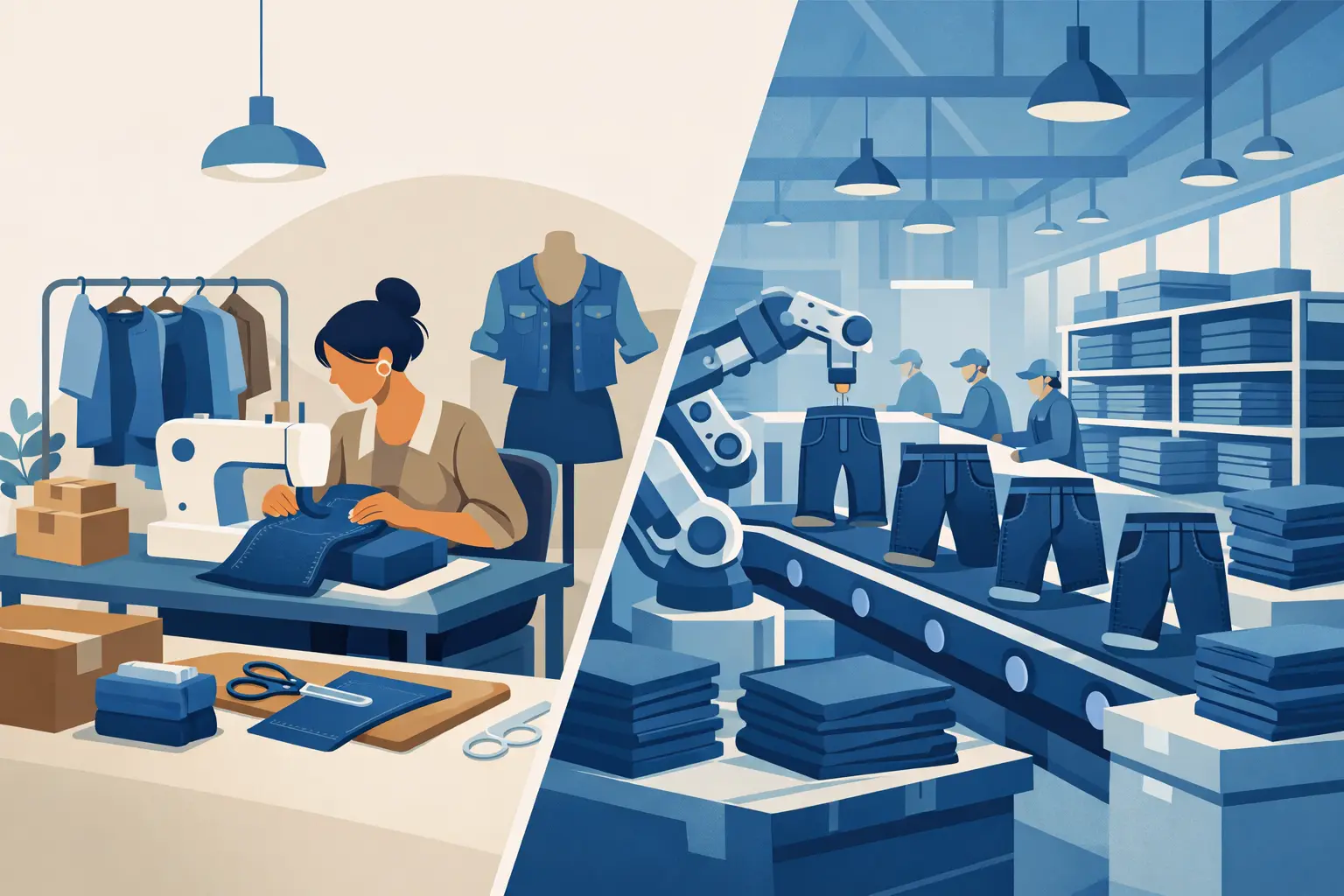
A denim order can look profitable on a spreadsheet and still become expensive inventory six months later. The choice between small batch vs bulk production affects more than unit price. It determines how quickly a brand can test demand, how much cash is tied up in stock, and whether a factory can maintain the same fit, wash, and finish as order volumes grow.
For fashion brands and sourcing teams, the right model is rarely about choosing the lowest quoted price. It is about matching production volume to sales confidence, seasonal timing, product complexity, and the operational capacity behind the order.
What Small Batch Production Means in Denim Manufacturing
Small batch production is a limited manufacturing run, typically used for new styles, capsule collections, market tests, replenishment programs, or brands with controlled inventory strategies. In denim, a small batch may involve a lower minimum order quantity across one style, wash, or color, rather than a full-scale production commitment.
This approach gives brands room to validate a product before placing a larger order. A new wide-leg jean, coated denim jacket, or heavily washed cargo skirt may look strong in development, but real market response is the only reliable demand signal. Producing a controlled first run allows a buyer to assess sell-through, returns, size performance, and customer feedback without carrying excessive stock.
Small batches are particularly useful when the product has technical variables. Denim washes can shift the hand feel, shade, shrinkage, and measurements of a garment. Specialty trims, embroidery, distressing, garment dyeing, and unusual fabric blends also introduce development risk. A smaller production run creates an opportunity to confirm that the approved sample translates consistently to finished units.
At Tuopu Apparel, a 300-piece MOQ supports brands that need commercial flexibility while still requiring professional pattern development, denim wash execution, and export-ready quality control.
Where Small Batches Create Value
The main advantage of small batch production is inventory control. Brands can commit less capital upfront and reserve more budget for marketing, product development, or proven replenishment styles. This is especially relevant for DTC brands managing cash flow around seasonal launches.
Speed to market can also improve when the order is focused and well-prepared. Once the fabric, trims, pattern, measurement chart, wash standard, and packing requirements are confirmed, a factory can move a limited run through production without the same material exposure associated with a large seasonal buy.
Small runs also support sharper merchandising decisions. Instead of ordering five washes of one jean at high volume, a brand may test two washes and scale the better seller. Rather than committing to a full size curve for a trend-led silhouette, it can review actual sales by size before the next order.
However, small batch production is not automatically faster or less demanding. Factories still need to source fabric, book wash capacity, prepare cutting markers, set sewing lines, and conduct inspections. A low MOQ does not remove the need for complete technical information. Incomplete specifications can delay a 300-piece order just as easily as a 10,000-piece order.
What Bulk Production Means for Denim Programs
Bulk production is designed for larger, repeatable orders with established demand. It is the correct model when a brand has reliable sales data, confirmed retail commitments, evergreen products, or a distribution plan that supports higher inventory levels.
For denim, bulk production generally produces stronger cost efficiency because fixed setup costs are distributed across more units. Fabric purchasing, wash development, cutting, sewing line allocation, finishing, packing, and freight planning all become more efficient at scale. Larger orders can also give buyers more options when negotiating fabric pricing, trim sourcing, and delivery scheduling.
The key distinction is not simply that bulk production means “more pieces.” It means a production program has enough volume and consistency to justify dedicated capacity planning. A factory can organize material procurement, allocate operators, standardize critical checkpoints, and manage output against an agreed delivery window.
For brands with ongoing core denim programs, bulk production can support predictable replenishment. A best-selling straight-leg jean in an established wash should not be treated like an experimental capsule style. When demand is proven, a larger production order can protect availability, improve margin, and reduce the risk of stock-outs during key sales periods.
The Advantages and Risks of Bulk Orders
The most visible benefit of bulk production is lower cost per unit. But that advantage matters only when the goods sell at the expected rate. A lower factory price can be outweighed by markdowns, warehousing costs, discounted freight, and lost working capital if the order is too large for actual demand.
Bulk orders also require greater discipline before production begins. A pattern adjustment discovered after thousands of jeans have been cut is costly. The same applies to a wash standard that is too light, a pocket placement that shifts after laundering, or a zipper specification that does not meet performance expectations. Approval stages must be treated as production controls, not formalities.
For larger denim programs, buyers should confirm the following before bulk cutting begins:
- Approved pre-production samples that reflect final fabric, wash, trims, labels, and construction
- Clear measurement tolerances and grading rules for every size
- Wash standards, shade band expectations, and acceptable variation limits
- Inspection requirements, packaging specifications, and labeling details
- A production and shipping schedule tied to the brand’s launch or delivery calendar
These controls reduce ambiguity between the approved sample and the goods that arrive at the warehouse.
Small Batch vs Bulk Production: The Decision Factors
There is no universal production volume that suits every denim brand. The right choice depends on the commercial role of the product and the quality of the information behind the order.
Demand Confidence
Use small batch production when demand is uncertain, the style is new, or the category is trend-sensitive. This is common for fashion washes, novelty silhouettes, and limited drops. Use bulk production when sales history, retailer purchase orders, preorder data, or reliable replenishment patterns support a larger commitment.
A brand does not need years of sales history to justify bulk. A confirmed wholesale order or a strong preorder campaign may provide enough demand visibility. The question is whether the volume is supported by evidence rather than optimism.
Product Complexity
Complex denim often benefits from a staged approach. Laser treatments, whiskering, hand sanding, uneven dye effects, patchwork construction, or multiple fabric panels should be developed carefully before scale. Small batches provide useful production feedback, particularly when wash effects can vary from garment to garment.
A basic five-pocket jean in a previously approved fabric and wash has fewer unknowns. If the factory has already proven the construction, grading, and finishing standard, bulk production becomes more practical.
Cash Flow and Inventory Exposure
Bulk orders require more upfront capital and more storage capacity. For a growing label, that can limit the ability to respond to new opportunities during the season. Small batches preserve flexibility, though the unit cost may be higher.
The right calculation includes more than the ex-factory price. Buyers should account for development costs, freight, duty, warehouse handling, expected markdowns, stock-out risk, and the cash value of inventory sitting unsold. A higher unit cost can be commercially smarter when it prevents a large inventory write-down.
Lead Time and Calendar Planning
A lower MOQ does not eliminate material lead times. Custom denim fabric, specialty hardware, branded trims, and complex washes may require advance planning regardless of order size. The best way to protect delivery is to begin development early and approve materials before the final production decision.
For many brands, the strongest model is not one extreme or the other. It is a planned sequence: develop quickly, launch in a controlled batch, review sales performance, then place a larger repeat order for proven styles. This approach combines market responsiveness with the cost advantages of scale.
Quality Control Must Scale With Volume
Quality consistency becomes more demanding as order quantity increases. A factory should control fabric inspection, shrinkage testing, pattern accuracy, cutting, sewing quality, wash results, measurements, finishing, packing, and final inspection throughout the process.
Denim requires particular attention because washing changes the garment after sewing. Measurements must be checked against the post-wash specification, not only before laundering. Shade variation, puckering, broken stitches, uneven distressing, trim function, and pocket alignment should be assessed against approved standards.
For bulk orders, buyers should expect defined checkpoints rather than relying on final inspection alone. Problems found at the end of production are harder to correct without affecting delivery. Early in-line and post-wash checks give the factory time to adjust before the full order is completed.
Build a Production Plan That Can Grow
Small batch and bulk production are not competing philosophies. They are tools for different stages of a product’s commercial life. Small runs protect a brand while it learns. Bulk orders improve efficiency once the product, demand, and specifications are proven.
The most effective sourcing strategy is to choose volume deliberately, not emotionally. Start with enough quantity to produce meaningful market data, establish clear approval controls, and scale only when the product has earned the investment. That discipline gives denim brands more room to move quickly without sacrificing consistency when demand arrives.
No responses yet