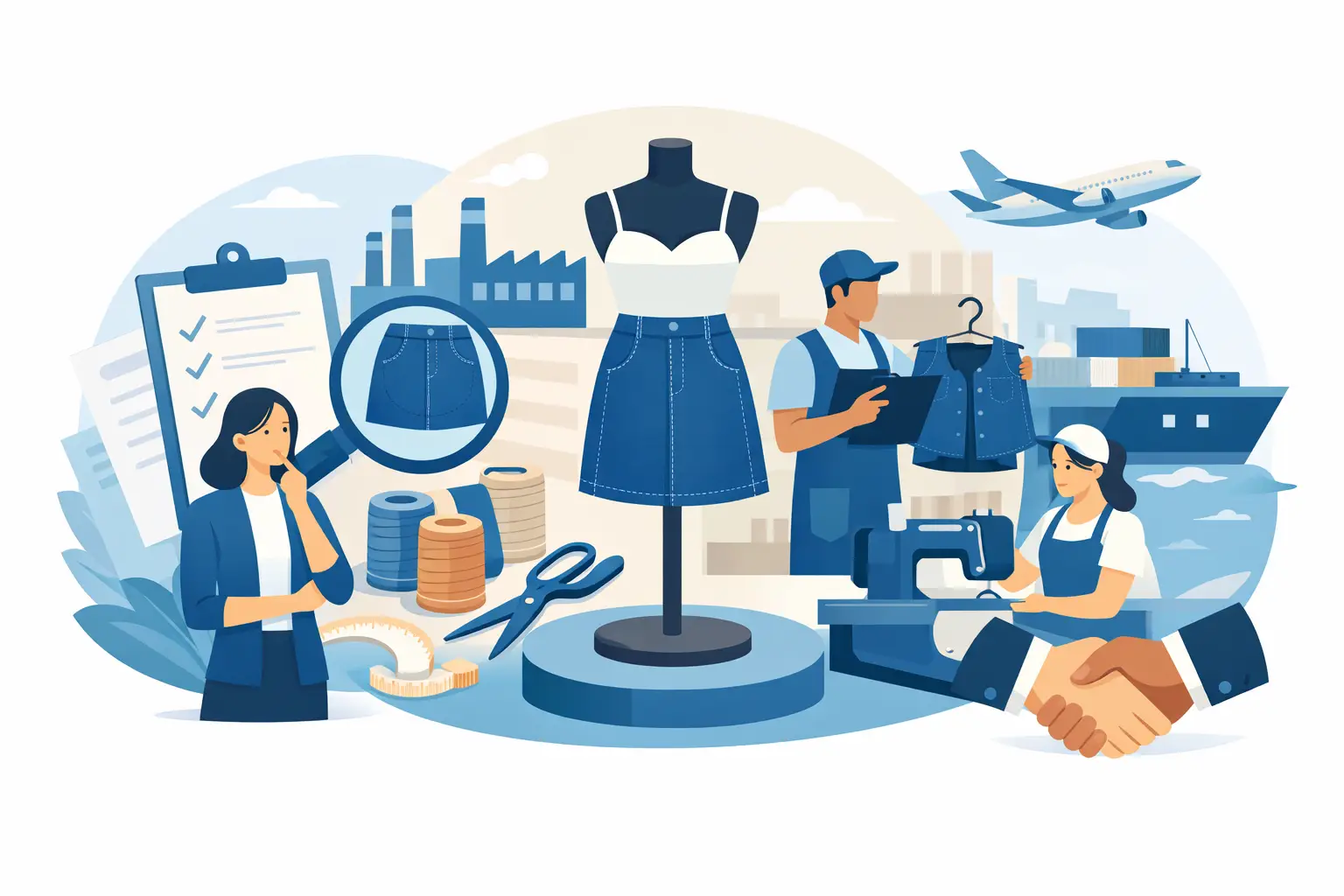
A denim skirt can look simple on a line sheet, but it is one of the easiest products to get wrong in production. Fit, wash consistency, hardware placement, hem finish, and fabric recovery all show up quickly at retail. That is why choosing the right denim skirt manufacturer is less about finding a factory that can sew denim and more about finding a partner that can control development, scale, and quality without slowing your launch.
For fashion brands, wholesalers, and retail buyers, the decision usually comes down to a few commercial realities. You need a supplier that can handle low to moderate MOQs, move samples quickly, execute trend-driven details accurately, and deliver repeatable bulk production. If one of those pieces fails, the product may still ship, but it will not perform the way it should in market.
What a denim skirt manufacturer should actually provide
A capable denim skirt manufacturer should offer more than cut-and-sew capacity. In practical terms, the job starts with product development and ends with shipment readiness. Between those points, there are several stages that directly affect cost, quality, and speed.
Pattern making is one of the first pressure points. Denim skirts rely on balance through the waist, hip, and sweep, and the grading must work across size ranges without distorting the silhouette. A factory that understands denim-specific fit will make better decisions on rise shaping, vent placement, panel construction, and waistband stability.
Fabric sourcing matters just as much. Some skirts need rigid cotton denim for a more structured look, while others require stretch blends for closer fits or comfort-driven styles. The right supplier should be able to advise on fabric weight, yarn character, shrinkage behavior, and wash suitability based on the intended design and price target.
Then comes wash development. This is where many products separate. A clean dark rinse, a vintage stone wash, an acid effect, or a destructed hem all require technical control. Good wash capability is not only about appearance. It also affects hand feel, shade consistency, strength retention, and repeatability from sample stage to bulk.
How to evaluate a denim skirt manufacturer for your brand
The best way to assess a denim skirt manufacturer is to look at how they manage risk. Most sourcing problems are predictable. Delayed samples, inconsistent measurements, wash variation, weak trims, and poor communication usually show up early if you know what to ask.
Start with MOQ and sampling speed
For many brands, MOQ determines whether a style is commercially viable. A factory that only wants large orders may not fit a seasonal test, a capsule drop, or a new label launch. Flexible MOQ is especially valuable when you are still validating fit, price, or demand.
Sampling speed is equally important. If a supplier takes too long to make the first prototype, the entire calendar gets compressed. That often leads to rushed approvals or missed delivery windows. A practical benchmark for many buyers is a sample lead time of around 10 to 15 days, assuming the tech pack and materials are clear.
Review technical execution, not just photos
Factory portfolios can look strong online, but flat images do not tell you how a skirt fits or how well it is built. Ask for evidence of construction capability. This includes waistband finishing, fly execution, pocket symmetry, seam durability, bar-tack placement, and clean topstitching.
If your design includes split hems, asymmetrical panels, raw edges, cargo pockets, patchwork, coated denim, or vintage washing, make sure the supplier has already produced comparable styles. Denim products are detail-sensitive. A factory may be excellent at basic five-pocket jeans and still struggle with fashion skirts that need sharper pattern control or more advanced wash coordination.
Check wash and finish consistency
Denim skirts often carry more visible wash risk than buyers expect. Shade mismatch across panels, over-sanded edges, puckering near seams, and inconsistent abrasion can all reduce perceived quality. This is especially true for mini skirts and fitted silhouettes, where every detail is easy to see.
A qualified supplier should have a clear wash development process, lab dip or shade approval steps where relevant, and practical controls for bulk consistency. If the factory cannot explain how they manage wash standards, rework thresholds, and final appearance approval, that is a concern.
Production capacity matters, but only if control comes with it
Many buyers ask about monthly output first. Capacity matters, but it should not be treated as a standalone selling point. High volume is useful only when the factory can maintain measurement accuracy, finishing quality, and on-time delivery as orders increase.
This is where process discipline becomes important. A strong manufacturer should be able to explain how they handle pre-production approvals, inline inspections, final quality control, and packing verification. If production expands but quality control does not, the risk shifts back to the buyer.
For growing brands, it helps to work with a supplier that can support both small launch quantities and larger repeat orders. That gives you room to test a style at a manageable commitment level, then scale without moving the program to another factory. Tuopu Apparel, for example, positions this kind of flexibility around low-MOQ development and dependable bulk manufacturing, which is often the balance buyers need.
The role of communication in denim skirt development
Communication is not a soft factor in manufacturing. It has direct impact on lead times, accuracy, and cost control. A factory can have strong production capability and still create delays if approvals, revisions, or technical questions are handled slowly.
The best suppliers communicate in a way that supports decisions. They flag potential issues early, confirm spec details before sampling, and provide realistic timelines instead of optimistic ones. That matters when you are working against seasonal deadlines or coordinating multiple SKUs across a collection.
It also matters during development changes. Denim skirts frequently go through revisions in fit, wash tone, length, pocket shape, and trim selection. A reliable manufacturer should be able to process those updates without losing control of the version history or confusing sample comments.
Cost is important, but costing structure matters more
Every buyer wants competitive pricing, but unit cost alone is not enough to evaluate a supplier. A lower quote may reflect weaker fabric, simplified construction, limited wash work, or less rigorous quality control. That can create bigger costs later through returns, markdowns, or failed reorder programs.
A better approach is to review the full costing structure. Understand what is included in the quoted price, what affects price movement, and where there may be trade-offs. Fabric composition, wash complexity, trim selection, order quantity, and packaging requirements all influence the final number.
This is also where an experienced denim manufacturer adds value. They can suggest construction or fabric adjustments that protect the look of the product while helping you hit the target margin. That kind of guidance is especially useful for newer brands that are still learning where to spend and where to simplify.
Export readiness and delivery reliability
A denim skirt program is only successful when goods arrive correctly packed, correctly labeled, and on schedule. Export readiness is often overlooked during supplier selection, but it becomes critical once an order is approved for bulk.
International buyers should confirm that the factory has experience with documentation, packing standards, inspection coordination, and shipment management. If the supplier serves brands in the US, Europe, and Australia, they should already understand the operational expectations that come with those markets.
Late delivery can damage more than one purchase order. It can disrupt launch dates, ad campaigns, wholesale allocations, and store floor sets. That is why reliable shipping support should be treated as part of the manufacturing service, not a separate afterthought.
What the right manufacturing partner looks like
The right denim skirt manufacturer is not simply the cheapest or the largest. It is the supplier that can translate your design into a saleable product, keep development moving, and hold quality through bulk production. For some brands, that means prioritizing low MOQ and fast samples. For others, it means stronger wash capability, higher monthly capacity, or better compliance structure. It depends on your business model and growth stage.
What should stay constant is the standard you use to evaluate the factory. Look for denim specialization, not general apparel experience alone. Look for process control, not just promises. Look for a supplier that can support your product from concept through shipment with the same level of precision at each stage.
A good denim skirt does not happen by accident. It comes from clear development, disciplined production, and a manufacturer that understands both the garment and the commercial pressure behind it. If your next collection needs speed, flexibility, and repeatable quality, the best decision is usually the one that reduces problems before they ever reach the production line.
No responses yet